
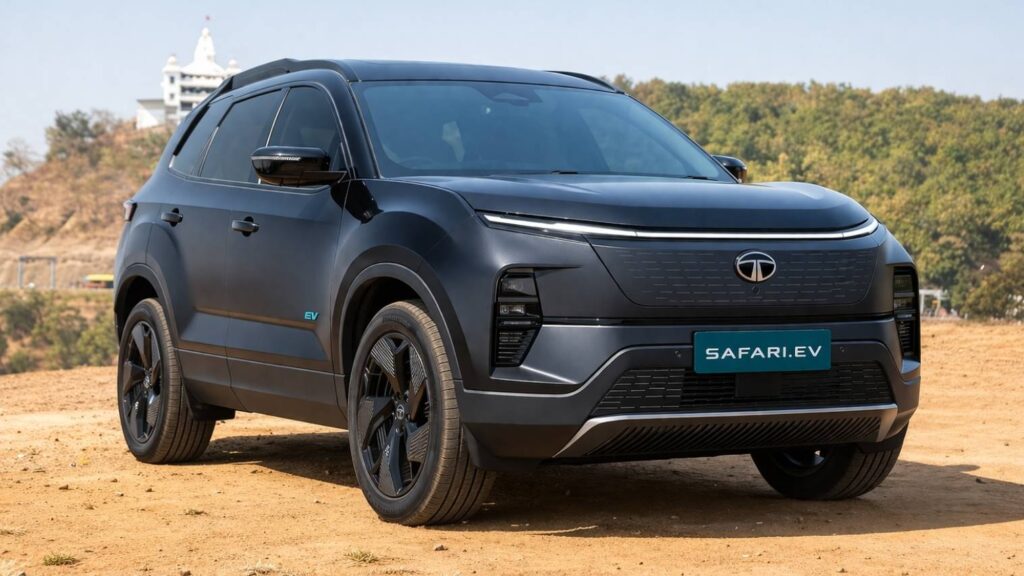
The Tata Safari EV launch date has become one of the most searched topics among Indian family car buyers in 2026. No other upcoming electric SUV combines a three-row cabin, an EV-native platform, and a sub-Rs 40 lakh target price in the same package. Tata Motors has confirmed the Safari EV is in development — the company’s own communications position it as a flagship electric SUV above the Harrier EV in their lineup. What remains unconfirmed is the exact commercial launch date, price band, battery specification, and powertrain breakdown. This article covers every detail currently known, clearly separating what Tata has confirmed from what industry reports estimate.
Tata Safari EV Launch Date in India — Official Status and What We Know
The Tata Safari EV launch date in India remains officially unannounced as of October 2026. Tata Motors confirmed the Safari EV is part of their near-term product plan and that the vehicle rides on the acti.ev+ architecture — but no production date, booking window, or commercial launch event has been scheduled in public communication.
The Tata Safari EV launch latest news from September 2026 points to a late 2026 or early 2027 commercial arrival. Industry reports had earlier speculated a festive season 2026 window covering October and November — industry analysis from September 2026 suggests the Safari EV is being readied with a 500 km range target and a dual-motor AWD option for a late 2026 launch, though Tata has not confirmed this timeline.
The Tata Safari EV launch date 2026 question is legitimate — Tata’s own product cadence in 2025 and 2026 has been aggressive, delivering the Harrier EV, Curvv EV, and Punch EV within an 18-month window. However, as of the third week of October 2026, no Safari EV launch event has been announced. The most credible current position: a late-2026 reveal remains possible, but a Q1 2027 commercial launch is the more frequently cited industry estimate.
Tata has confirmed the three-row layout and the acti.ev+ platform for the Safari EV. Everything else — final price, battery choice, powertrain configuration, trim structure, and booking date — remains unconfirmed. Buyers tracking updates should monitor tatamotors.com directly rather than relying on third-party aggregator reports, which carry no manufacturer backing.
Platform and Architecture — acti.ev+ and What It Means for Safari EV Buyers
The Safari EV rides on Tata’s acti.ev+ architecture, the extended and higher-capacity version of the acti.ev platform that underpins the Tata Harrier EV platform. The two platforms share the same EV-native design philosophy — no ICE transmission tunnel, flat floor, and OTA update capability baked in — but acti.ev+ carries a longer wheelbase envelope and a higher battery capacity ceiling designed to support larger vehicles.
The Safari EV’s base configuration is expected to use a rear-wheel drive electric SUV layout with a single motor, while the top trim is widely expected to offer an all-wheel drive electric SUV configuration. A dual-motor electric powertrain would power the AWD variant — consistent with the Harrier EV’s AWD setup, which Tata has already confirmed for that model. No power or torque figures for the Safari EV have been released by Tata Motors; any output numbers in current reports are estimates from the Harrier EV’s confirmed figures scaled to the larger platform.
The platform architecture matters beyond the drivetrain. acti.ev+ brings vehicle-to-load (V2L) support, Level 2 ADAS integration at the system level, and over-the-air update capability — features the Harrier EV already demonstrates and the Safari EV is expected to carry forward.
acti.ev+ vs acti.ev: Key Technical Differences
The Harrier EV uses acti.ev and tops out at a 65 kWh battery pack. The acti.ev+ on the Safari EV is designed to accommodate the 75 kWh pack that industry reports reference as the top-variant option. The chassis length envelope on acti.ev+ is longer, enabling the third row without compromising second-row legroom. Motor output ceiling on acti.ev+ is also higher, supporting the AWD dual-motor configuration that the base acti.ev may not support at the same power level. No confirmed output figures exist from Tata for either acti.ev+ motor configuration.
Tata Safari EV Battery, Range and Charging — What the Specs May Look Like
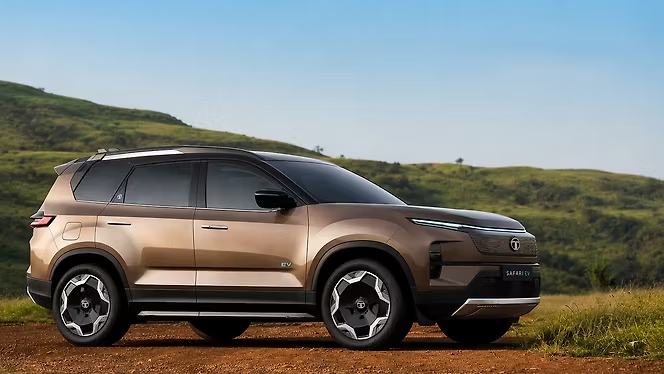
Two battery options appear consistently across industry reports for the Safari EV: a 65 kWh battery pack (shared with the Harrier EV’s top variant) and a larger 75 kWh battery pack unique to the Safari EV. Tata has confirmed neither figure. Both should be treated as estimates extrapolated from the Harrier EV’s confirmed specifications and the acti.ev+ platform’s reported capacity ceiling.
65 kWh pack estimates: The Harrier EV delivers a certified 500 km MIDC range with this pack in a two-row, five-seat body. The Safari EV’s heavier three-row structure will reduce that figure — industry estimates suggest 420-460 km MIDC-certified range in the Safari EV body. Real-world range in Indian conditions, accounting for sustained AC use, city stop-start patterns, and load weight, typically runs 20-25% below the certified figure. Practical planning range: approximately 320-360 km per charge in mixed city and highway use.
75 kWh pack estimates: Reports suggest a 500+ km MIDC claim is Tata’s target for the larger pack in the Safari EV body. Real-world planning range: approximately 380-420 km per charge — enough to cover Delhi to Jaipur (approximately 285 km) in a single charge with meaningful buffer.
Electric SUV charging range expectations: DC fast charging at 150 kW is expected, matching the Harrier EV’s confirmed charging spec and delivering 10-80% in approximately 30-35 minutes. Home AC charging uses a 7.2 kW onboard charger. V2L support is expected at launch, allowing the Safari EV to power appliances or other devices directly from the battery. All charging specifications remain unconfirmed by Tata Motors for the Safari EV specifically.
The Tata Safari EV expected launch date — whenever it materialises — will trigger a production specification release that replaces all current estimates. Until that point, the Harrier EV’s confirmed 500 km MIDC / approximately 350 km real-world range is the closest verified reference for the platform’s capability.
Tata Safari EV Interior — Triple-Screen Dashboard, Passenger Display and Cabin Features
The Safari EV concept interior Tata has shown in its communications features a triple-screen dashboard spanning the full width of the cabin: a large driver display, a central infotainment touchscreen, and a passenger-side display — a feature currently absent from every other production vehicle in India’s SUV market. Whether the production version retains the full triple-screen setup or simplifies it for cost management is unconfirmed. The passenger-side display is the feature most likely to be limited to a top trim or dropped in the production transition.
The panoramic sunroof shown on the concept is expected to carry into the production version as a premium upper-trim feature. Given the Safari ICE already offers a panoramic sunroof in its higher variants, the Safari EV dropping it would be a step backward that Tata is unlikely to take at this price point.
The 540-degree camera system referenced in Tata’s concept materials provides a bird’s-eye surround view — particularly useful for parking a long three-row SUV in tight urban spaces. Whether this system is standard across variants or reserved for a top trim is unconfirmed.
The most consequential cabin upgrade over the ICE Safari is the flat floor. Moving to an EV-native platform eliminates the transmission tunnel, creating genuine flat-floor access for second and third-row passengers. Third-row entry and exit ease improves meaningfully, and second-row captain seats become a more comfortable option without the central tunnel intrusion.
Level 2 ADAS is expected to include adaptive cruise control, lane keep assist, forward collision warning, and automatic emergency braking — the same suite as the Harrier EV. Boot capacity with the third row folded is unconfirmed in litres; it is expected to be competitive with the ICE Safari’s 447-litre figure with the third row down. Ambient lighting, wireless charging, and Tata’s connected car suite (ZConnect or its successor) are expected throughout upper trims.
Tata Safari EV Price and Launch Date — What to Expect and How It Positions
Tata Safari EV price and launch date are the two most consequential unknowns. On price: no ex-showroom figure has been confirmed by Tata Motors. Industry estimates range from Rs 28 lakh to Rs 40 lakh ex-showroom across variants. The premium over the Harrier EV (estimated at Rs 21-28 lakh at its launch) reflects the larger platform, third-row seating, and the higher-capacity 75 kWh battery option. On-road price for the top variant, factoring road tax and insurance at 10-15% over ex-showroom, would place it at approximately Rs 32-46 lakh on-road for buyers in major metros — unconfirmed.
Tata Safari EV launch date 2027: Q1 2027 (January through March) is the most consistently cited window across automotive media as of October 2026. A festive season 2026 launch was speculated from mid-year and has not materialised by the time of writing. If Tata follows its recent pattern of using the Bharat Mobility Global Expo as a reveal platform, a January 2027 unveil with a February or March delivery start is plausible — but entirely unconfirmed.
Tata Safari EV launch month: no specific month has been named by Tata Motors. Watch for a formal announcement on tatamotors.com; that will be the first reliable signal ahead of any media launch event.
Tata Safari EV booking date in India: no booking portal is open as of October 21, 2026. When Tata does open bookings, the standard process applies: an official portal on tatamotors.com, a token booking amount in the range of Rs 11,000-21,000 based on recent Tata EV launches, and a communicated delivery timeline at that point.
As Tata’s flagship electric SUV in the current lineup, the Safari EV will sit above the Harrier EV, Nexon EV, and Punch EV in both size and price. It enters a market segment where it has no direct Indian-OEM competition: the Kia EV9 targets a buyer spending above Rs 1 crore, and the MG Gloster EV has not confirmed an India launch date. The Safari EV, if it arrives in the estimated price window, becomes India’s most affordable mass-market seven-seater electric SUV by a significant margin.
The connected car technology expected in the Safari EV — OTA updates, remote diagnostics, app-based controls — extends what the Harrier EV already offers; buyers can read more about connected car technology and how it is changing ownership for Indian families.
Tata Safari EV vs Harrier EV and ICE Safari — How They Compare
The Safari EV occupies a distinct position in the Tata Motors EV lineup — above the Harrier EV in size, seating, and expected price, and above the ICE Safari in platform technology. For buyers currently on an ICE Safari considering an upgrade, or buyers on the Harrier EV shortlist who need a third row, this comparison table covers the key decision points.
| Feature | Tata Safari EV (Expected) | Tata Harrier EV | Tata Safari ICE |
|---|---|---|---|
| Seating | 7 (3 rows) | 5 (2 rows) | 7 (3 rows) |
| Platform | acti.ev+ (EV-native) | acti.ev (EV-native) | Impact Pro (ICE-adapted) |
| Battery | 65/75 kWh (est.) | 65 kWh (confirmed) | Petrol / Diesel |
| Real-World Range | 320-420 km (est.) | ~350 km | ~12-16 km/l |
| AWD Option | Expected (dual-motor) | Yes (confirmed) | Yes (petrol AWD) |
| Triple Screen | Expected | No | No |
| Price (est.) | Rs 28-40 lakh | Rs 21-28 lakh (est.) | Rs 16.19-26.69 lakh |
| Availability | Expected Q1 2027 | Available now | Available now |
Safari EV figures are unconfirmed industry estimates. Harrier EV pricing estimated at launch. ICE Safari prices as of October 2026.
Who should wait: buyers who need seven seats, want the flat floor and EV running economics, and can defer a purchase until Q1 2027. Who should buy now: buyers who need a car before Q1 2027, find five seats adequate, or want a confirmed specification and available inventory — the Harrier EV on the same platform is available today.
Tips for Buyers Tracking the Tata Safari EV Launch Date
Follow only tatamotors.com for the Tata Safari EV launch date. Automotive portals report usefully on what is known, but the manufacturer’s website carries the first confirmed announcement. Third-party reports on the Tata Safari EV launch date should be read as context, not confirmation.
Do not pay advance deposits to unofficial sources. No Tata Safari EV booking date in India exists as of October 2026. Any website requesting a pre-booking deposit is not authorised by Tata Motors and offers no refund guarantee if the product timeline changes.
Test drive the Harrier EV as a platform preview. The Harrier EV uses the same acti.ev family of platforms and gives buyers an accurate read on ride quality, NVH refinement, charging experience, and infotainment behaviour. The Tata Safari EV launch latest news consistently confirms platform continuity — the Safari EV improves on the Harrier EV’s foundation, it does not replace it with a different architecture.
Calculate total cost of ownership. A Safari EV estimated at Rs 30-35 lakh ex-showroom running on home charging costs approximately Rs 0.8-1.2 per km. A comparable diesel seven-seater costs Rs 8-12 per km in fuel alone. For an electric family SUV India buyer covering 1,500 km per month, the fuel savings over five years comfortably offset the EV price premium. Factor in lower servicing costs as well — fewer moving parts, no oil changes, regenerative braking extending pad life.
The connected car technology suite — OTA software updates, remote monitoring, vehicle health alerts — that the Safari EV is expected to carry changes the ownership experience in ways that matter across a typical five-to-seven year ownership cycle. Understanding what the platform delivers is useful before committing.
Plan timelines around Q1 2027, not 2026. If a trade-in or budget allocation depends on a Safari EV delivery date, structure it around January-March 2027. A 2026 delivery was possible earlier in the year — it has not happened as of October 2026.
FAQ — Tata Safari EV: People Also Ask
Q1: What is the Tata Safari EV expected launch date? Industry reports as of October 2026 point to Q1 2027 — January through March — as the most likely commercial launch window. A festive season 2026 launch was speculated earlier and did not happen. Tata Motors has not confirmed any launch date. Watch for a possible announcement at the Bharat Mobility Global Expo in January 2027 if Tata follows its established pattern of using that platform for major EV reveals.
Q2: Will the Tata Safari EV launch in 2026 or 2027? A 2026 launch has not occurred as of the third week of October 2026. The Q4 2026 festive window is effectively closed for a full commercial launch. Q1 2027 is now the most frequently cited target across credible automotive media. Tata Motors has confirmed none of these timelines; all remain industry estimates.
Q3: What is the Tata Safari EV price and launch date? Tata Safari EV price and launch date are both unconfirmed. Industry estimates place the ex-showroom range at Rs 28-40 lakh across variants. The premium over the Harrier EV is expected to reflect the acti.ev+ platform’s larger battery capability, the three-row cabin, and the higher-capacity powertrain options. No Tata Motors spokesperson or official document has stated a price.
Q4: Has Tata Motors opened bookings for the Safari EV? No. The Tata Safari EV booking date in India has not been announced, and no official booking portal is open as of October 2026. Authorised Tata dealerships are not accepting reservations. When bookings open, the process will run through tatamotors.com with a token amount of Rs 11,000-21,000 — consistent with recent Tata EV launch procedures for the Nexon EV facelift and Curvv EV.
Q5: How many seats does the Tata Safari EV have, and what range will it deliver? The Safari EV features a seven-seat three-row layout — confirmed by Tata in its product communications. Battery options of 65 kWh and 75 kWh are widely reported in industry estimates; neither is confirmed. Real-world range estimates based on the acti.ev+ platform and the Harrier EV’s confirmed specs suggest approximately 320-360 km (65 kWh pack) and 380-420 km (75 kWh pack) in Indian mixed-use conditions. Tata has published no official range figure for the Safari EV as of October 2026. At launch, this would make it India’s longest-range seven-seater electric SUV — if the 75 kWh range estimate holds in the production specification.
Tata Safari EV: The Right Call Is Clear — Once the Date Is Confirmed
The Tata Safari EV launch date matters because the product itself is genuinely consequential. No Indian OEM currently sells a mass-market three-row electric SUV on an EV-native platform in this price bracket — not at Rs 28 lakh, not at Rs 35 lakh, not at Rs 40 lakh. When the Tata Safari EV launch date in India is announced, it will open a category, not just add a model.
The honest position for buyers in October 2026: the wait continues, but the direction is clear. Tata has confirmed the platform, the seating layout, and the flagship positioning. The gap between what is confirmed and what buyers need to decide — price, battery choice, exact month — will close when Tata announces the launch. Until then, an ICE Safari or Harrier EV serves a buyer who cannot defer.
For buyers who can wait: the Tata flagship electric SUV in a seven-seat, flat-floor, 380-420 km real-world range package with a triple-screen dashboard and Level 2 ADAS, at a price point below Rs 40 lakh, is a product worth structuring a timeline around. That is the case for the Safari EV — and the confirmation, when it comes, will move quickly from announcement to booking to delivery.