

The Indian compact SUV segment no longer treats safety as a checkbox — it is now a primary shortlist criterion for buyers. The Hyundai Bayon safety features address this shift head-on. Launching on October 26, 2026, the Bayon arrives with over 80 advanced and 35 standard safety systems across its variants — including 23 Level 2 ADAS functions, six airbags, and a high-strength body structure built on the Global K Enhanced Platform.
This article covers every layer of protection the Bayon offers: the structural foundation, the passive safety net, the full active ADAS suite, a trim-level breakdown, a competitor comparison, and practical buying tips for Indian road conditions.
Hyundai Bayon Safety Features in India — What Makes It Stand Out in the Compact SUV Segment
The Hyundai Bayon safety features in India represent a two-layer philosophy — structural and passive safety first, active crash prevention second. This approach means that regardless of which variant a buyer chooses, the car provides a meaningful baseline of protection, while the top trims add an active ADAS layer that currently has no equivalent at this price point in India.
The Hyundai Bayon safety features 2026 package positions the car squarely between the Venue and Creta — not just in price, but in safety specification. The Global K Enhanced Platform underpins the entire structure, and all variants are expected to ship with six airbags as standard (confirm with Hyundai India at launch). At the top variant, Hyundai’s SmartSense Level 2 Pro ADAS adds 23 active functions covering forward collision, lane discipline, blind-spot monitoring, highway assist, and driver fatigue detection.
The Hyundai Bayon standard safety features — present across all trims regardless of price point — include Electronic Stability Control, Hill-Start Assist Control, Tyre Pressure Monitoring System, ISOFIX child-seat anchorages, three-point seat belts for all five positions, and Emergency Stop Signal. These are the systems that every Bayon buyer gets on day one.
Global K Enhanced Platform — The Foundation of Hyundai Bayon Crash Safety Features
The Hyundai Bayon crash safety features begin before any airbag deploys. The Global K Enhanced Platform is the structural architecture that determines how crash energy moves through the vehicle in the first 100 milliseconds of an impact — before occupant restraints even activate.
This platform uses a high-strength steel body structure where crash-critical zones — the A-pillar, B-pillar, roof rail, and door sill — carry significantly higher proportions of high-tensile steel than conventional compact SUV construction. The result is a body that absorbs and redirects crash energy into engineered crumple zones at the front and rear, rather than allowing it to travel into the occupant cell.
The crumple zone geometry, side-impact door beams, and floor-pan reinforcement are calibrated as integral parts of the platform design. These are not aftermarket-style additions — they are designed from the ground up as a system. Vehicles built on purpose-built high-strength platforms consistently outperform conventionally constructed bodies in offset frontal, side pole, and small overlap crash tests, because energy management is engineered in rather than patched in.
As of October 2026, the India-spec Hyundai Bayon has not undergone Bharat NCAP or Global NCAP testing, and no official crash test rating has been published. Buyers should monitor the Bharat NCAP website for updates as testing results are released. The Hyundai Bayon safety rating in India will be established through official testing — the platform pedigree suggests strong structural performance, but a star rating requires independent verification.
Three-point seat belts at all five seating positions — including the rear centre — amplify airbag effectiveness in a collision. Many budget compact SUVs still fit a two-point lap belt at the rear centre; the Bayon’s three-point fitment at every position is a meaningful passive safety advantage for rear occupant protection.
High-Strength Steel and What It Means for Real-World Safety
In practical terms: high-strength steel in the B-pillar resists lateral intrusion in a side impact, keeping the door from collapsing into the occupant space. The sill reinforcement protects the floor in an underside impact or kerb strike. The roof structure resists crush in a rollover — directly relevant on Indian highways where rollover accidents account for a disproportionate share of fatalities.
A vehicle can earn four stars in a crash test with a conventional body structure if it deploys enough airbags and pre-tensioners. The Global K platform targets structural resistance as the first line of defence, reducing the load placed on supplemental restraints. This matters because airbag effectiveness is maximised when the occupant cell retains its geometry through the crash — something a weak body structure cannot guarantee regardless of airbag count.
The Global K platform spans multiple Hyundai models globally, giving it a development pedigree that single-model body structures cannot claim.
Hyundai Bayon Six Airbags and ADAS — Every Layer of Passive Protection
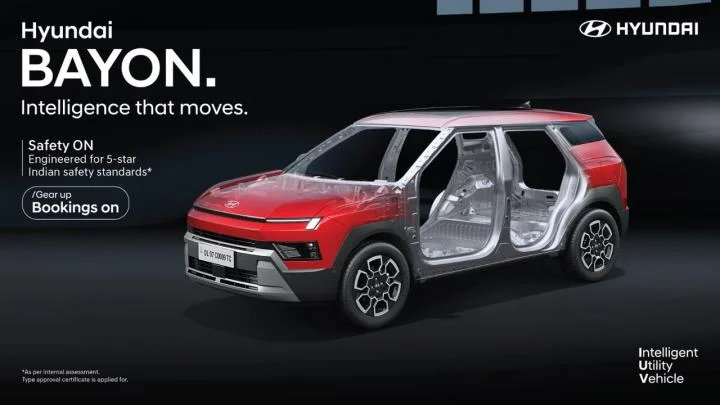
The Hyundai Bayon six airbags and ADAS package represents the full passive restraint system working in concert with active electronics. The six airbags span dual front airbags (driver and front passenger), front side airbags, and full-length curtain airbags that deploy from the roofline across both front and rear rows.
The curtain airbag is the most underappreciated element in this list. Unlike front airbags that protect front occupants only, curtain airbags deploy as a full-length membrane from the A-pillar to the C-pillar, covering head protection for all four outboard seating positions in a side impact or rollover. Rear passengers — including children — receive the same head protection as front occupants.
ISOFIX child-seat anchorages at the rear outboard seats allow compatible child seats to attach directly to the car’s structural frame rather than relying on belt routing. The practical advantage for Indian families: ISOFIX eliminates installation error — the single largest risk factor in child seat safety when using belt-only installation. Buyers should verify their specific child seat’s compatibility with the Bayon’s ISOFIX geometry at the dealership before purchase.
Three-point seat belts across all five positions confirm what the airbag count implies: rear occupant protection is not an afterthought. The rear centre position — most commonly a two-point lap belt even on mid-range SUVs — gets a three-point belt, meaningfully improving restraint in a frontal impact for the centre rear occupant.
The Emergency Stop Signal (ESS) activates hazard lights automatically under heavy braking above a threshold speed, alerting following traffic to an emergency stop. On Indian highways — where rear-end collisions account for a significant share of multi-vehicle pileups — this passive electronic function requires no driver input and operates every time the brakes are applied hard.
The Tyre Pressure Monitoring System (TPMS) provides real-time alerts for underinflated tyres. On Indian national highways, tyre blowouts from chronic underinflation are a documented cause of high-speed accidents; TPMS gives the driver early warning before a blowout scenario develops.
Electronic Stability Control (ESC) detects oversteer and understeer through wheel speed and steering angle sensors, applying selective braking to individual wheels to restore directional stability. Hill-Start Assist Control (HAC) holds braking for 2-3 seconds on uphill starts, preventing rollback on inclined intersections, flyover entry ramps, and multi-storey parking ramps — a daily-driving reality in Indian cities.
Taken together, these passive systems function as a last-resort protection net. The ADAS systems in the following section operate upstream — preventing the collision from occurring in the first place.
Hyundai SmartSense Level 2 Pro ADAS — Every Active Safety System Explained
The Hyundai Bayon Level 2 ADAS features are what separate the top-spec Bayon from every comparably priced compact SUV in India. Hyundai Bayon safety technology explained starts with the hardware: three radars and twelve ultrasonic parking sensors form the sensing backbone. Level 2 means the system can simultaneously control steering and speed under defined conditions — not autonomous driving, but genuine driver assistance that reduces workload and fatigue on long highway runs.
The Hyundai SmartSense Level 2 Pro ADAS suite covers 23 functions. The key systems:
Forward Collision-Avoidance Assist (FCA) detects vehicles, pedestrians, and cyclists ahead. If the driver does not respond to an alert, the system applies autonomous emergency braking. It operates across city and highway speeds and includes junction-crossing detection — relevant for India’s unprotected intersections.
Forward Collision Warning (FCW) is the alert layer before FCA activates — audible and visual warnings that give the driver priority to brake. FCA intervenes only if the driver does not respond within the warning window.
Lane Keeping Assist (LKA) applies gentle corrective steering input if the vehicle drifts across a lane line without an active turn signal. It operates above approximately 60 kph and is designed for marked-lane highways and expressways.
Lane Departure Warning (LDW) precedes LKA — a steering vibration or auditory alert warns the driver before the corrective steering input engages.
Highway Driving Assist (HDA) combines Smart Cruise Control with Stop and Go and lane centring to maintain both speed and lane position simultaneously on highways. It operates between 0 and approximately 145 kph. The Stop and Go capability brings the vehicle to a complete stop in slow traffic and resumes automatically when the vehicle ahead moves — directly applicable to Indian highway toll queues and expressway traffic jams.
Smart Cruise Control with Stop and Go (SCC) handles the speed and following-distance management component. It operates independently of lane centring when HDA is not engaged.
Blind-spot Collision-Avoidance Assist (BCA) uses rear corner radar to monitor the blind-spot zones. If a vehicle is detected in the blind spot during a lane change, it alerts the driver and applies corrective braking to prevent the lane change from completing.
Blind-spot View Monitor (BVM) displays a live camera feed of the blind-spot zone on the instrument cluster when the turn signal is activated. It operates at any speed — useful in city driving where BCA radar thresholds may not yet be met.
Rear Cross-Traffic Collision-Avoidance Assist (RCCA) detects vehicles approaching from the sides when reversing and applies autonomous braking if the driver does not stop. This is particularly relevant in Indian urban parking situations where reversing out of a bay into oncoming traffic is a routine hazard.
Driver Attention Warning (DAW) monitors steering input patterns to identify drowsiness and distraction. It alerts the driver to take a break when patterns suggest fatigue — operating above approximately 60 kph, covering the highway segment where fatigue-related crashes peak.
Safe Exit Warning (SEW) alerts all occupants when a vehicle or cyclist approaches from behind while a door is being opened. It covers both front and rear doors — directly relevant on Indian roads where two-wheelers regularly pass parked vehicles at close range.
Three Radars and Twelve Parking Sensors: The Hardware Behind Hyundai SmartSense
Radar-based ADAS is more reliable than camera-only systems in Indian conditions. Fog, dust haze, monsoon rain, and night driving all reduce camera effectiveness. Radar operates through these conditions unimpaired, which is why the Bayon’s radar-dependent functions — FCA, BCA, SCC, RCCA — remain operational regardless of visibility or road surface markings.
The front radar handles forward collision detection, adaptive cruise control, and HDA speed management. The two rear corner radars cover blind-spot monitoring, rear cross-traffic, and RCCA. Together, the three radars provide 270-degree active sensing coverage around the vehicle.
The twelve ultrasonic parking sensors — four front, four rear, four corner — provide a complete proximity picture around all four corners. Most compact SUV competitors offer four to eight sensors; twelve sensors eliminate the detection gaps that corner sensors typically leave.
The Surround View Monitor (SVM) — a 360-degree camera system stitching four camera feeds into a bird’s-eye view — is expected on the top variant for manoeuvring in tight urban spaces. Confirm availability and trim-level fitment with Hyundai India at launch. The Bayon’s connected car technology extends further through Hyundai’s BlueLink platform, which integrates over 70 connected features with the safety suite via the generative AI voice assistant.
Hyundai Bayon vs Compact SUV Competitors — Safety Feature Comparison
The Hyundai Bayon safety features stack up against key rivals as follows. Note that all competitor specifications should be verified against current variant-level feature lists before purchase.
| Safety Feature | Hyundai Bayon | Maruti Fronx | Tata Nexon | Kia Sonet | Mahindra XUV 3XO |
|---|---|---|---|---|---|
| Airbags (standard) | 6 | 6 | 6 | 6 | 6 |
| Level 2 ADAS | Yes (SmartSense Pro) | No | No | Yes (Level 2) | Yes (Level 2) |
| Highway Driving Assist | Yes | No | No | Yes | Yes |
| Blind-Spot Monitoring | Yes (radar) | No | No | Yes | Yes |
| Rear Cross-Traffic Alert | Yes | No | No | Yes | Yes |
| 360-degree Camera | Yes (SVM, top trim) | No | No | No | Yes |
| ESC | Yes | Yes | Yes | Yes | Yes |
| TPMS | Yes | Yes | Yes | Yes | Yes |
| Crash Test Rating | Not yet tested (Oct 2026) | Not yet (2026 model) | 5-star Bharat NCAP | Under evaluation | 5-star Bharat NCAP |
Features as of October 2026. ADAS availability on Bayon, Sonet, and XUV 3XO is trim-dependent. Verify variant-level specs before purchase.
The post-table picture: the Hyundai Bayon safety rating in India remains pending official testing. The Tata Nexon and Mahindra XUV 3XO have both achieved 5-star Bharat NCAP ratings, setting the structural benchmark in this segment. Where the Bayon claims competitive advantage is active safety — the SmartSense Level 2 Pro suite with radar-based BCA, HDA with Stop and Go, and Safe Exit Warning gives it a more comprehensive active suite than the Sonet’s Level 2 package on specific functions. Buyers who prioritise crash test ratings should monitor Bharat NCAP as Bayon testing results publish; buyers who prioritise active crash prevention have the Bayon’s ADAS as the current segment-leading package at this price.
Trim-Level Breakdown — Which Hyundai Bayon Variant Gets Which Safety Features
The Hyundai Bayon standard safety features are consistent across all variants. Every Bayon — from the entry-level trim to the top — ships with six airbags, ESC, HAC, ESS, TPMS, ISOFIX, and three-point belts for all five positions. The Global K Enhanced Platform is not a trim-dependent feature; the structural protection is the same across the range.
The Hyundai Bayon safety features 2026 variant structure is expected to span three trims — a base (HX2), a mid (HX10 MT), and a top (HX10 iVT) — with expected ex-showroom pricing in the Rs 9.79 to 17.50 lakh range. Official variant names and confirmed ex-showroom prices are scheduled for announcement on October 26, 2026; all pricing above is subject to confirmation.
The Hyundai Bayon Level 2 ADAS features — all 23 SmartSense Pro functions, the Surround View Monitor, Blind-spot View Monitor, and the full twelve-sensor parking array — are expected to be restricted to the top variant. This is the standard Hyundai tiering: passive safety is standard-spec across all variants, active ADAS is a top-trim differentiator. A buyer who selects the mid-variant for budget reasons receives the full structural and passive safety package but forgoes the active crash-prevention layer. The passive safety — body structure, airbags, ESC — is the same; the gap is entirely in the active layer. For buyers who regularly drive on highways or expressways, the top variant’s ADAS premium is the most meaningful safety investment in the Bayon range.
Tips for Buyers Evaluating the Hyundai Bayon Safety Package
1. Do not shortlist on airbag count alone. The Hyundai Bayon safety features go beyond the six airbags that most compact SUVs now offer as standard. Every rival in this comparison table also offers six airbags. What differentiates the Bayon is the Global K Enhanced Platform — the high-strength steel body structure that determines how well those airbags actually protect occupants when a crash occurs. A six-airbag car on a weaker body structure can underperform a four-airbag car on a purpose-built high-strength platform in a real-world crash. Wait for Bharat NCAP test results to put structural performance in comparable star-rating terms.
2. Understand what Level 2 ADAS does and does not do. Hyundai Bayon safety technology explained clearly: Level 2 means the car can manage steering and speed simultaneously under defined conditions, but it does not make the car autonomous. The driver must remain alert and in control at all times. Functions like HDA and LKA operate primarily above 60 kph on marked-lane highways — not in low-speed Indian city traffic where lane markings are absent or inconsistent. Buyers expecting Level 2 to handle Mumbai or Delhi city driving without constant driver oversight will encounter frequent system disengagement.
3. Verify which SmartSense features work in Indian road conditions. Hyundai SmartSense Level 2 Pro ADAS was calibrated for global markets with well-maintained road infrastructure. Camera-dependent functions — LKA, LDW, HDA lane centring — require clearly painted lane markings to operate correctly. On Indian highways where lane markings fade or are absent, these functions may disengage frequently or generate false alerts. Radar-based functions — FCA, BCA, SCC, RCCA — operate independently of road markings and are fully functional in Indian conditions including fog, dust, and night driving. For a detailed explanation of how connected car technology integrates with vehicle safety systems, including OTA updates that can refine ADAS calibration for local conditions, the link provides additional context.
4. Check ISOFIX compatibility with your child seat before purchase. ISOFIX mounts are present on the Bayon’s rear outboard seats, but not every child seat design is geometrically compatible with every ISOFIX anchor configuration. Before finalising the purchase, bring the specific child seat to a dealership and confirm it seats and locks correctly in the Bayon without adapters. This is a one-time dealership visit that removes the most significant risk in child seat installation.
5. The full Hyundai Bayon safety features value case is built around the top variant. The structural and passive safety — body platform, six airbags, ESC, ISOFIX — is consistent across all trims. But the 23-function active safety suite, including HDA, BCA, RCCA, DAW, and SEW, is reserved for the top trim. Buyers on the mid-spec variant receive a structurally safe car; they give up the active crash-prevention layer that represents the Bayon’s strongest competitive advantage. For highway-frequent buyers, the price differential between the mid and top variants should be weighed against the safety capability difference, not just the feature list.
FAQ: Hyundai Bayon Safety Features — People Also Ask
Q1. What are the Hyundai Bayon safety features available in India?
The Hyundai Bayon safety features include six airbags (dual front, front side, full-length curtain), the Global K Enhanced Platform high-strength steel body, ESC, HAC, ESS, TPMS, ISOFIX rear anchorages, and three-point seat belts for all five positions — across all variants. The top variant adds 23 Level 2 ADAS functions under the SmartSense Pro designation, including FCA, FCW, LKA, LDW, HDA, SCC with Stop and Go, BCA, BVM, RCCA, DAW, and SEW, plus the Surround View Monitor, twelve parking sensors, and three radars.
Q2. What is the Hyundai Bayon safety rating in India?
As of October 2026, the India-spec Hyundai Bayon has not undergone Bharat NCAP or Global NCAP testing. No official crash test rating has been published. The Hyundai Bayon safety rating in India will be determined when Bharat NCAP publishes test results — buyers should check the Bharat NCAP website for updates. The car is built on the Global K Enhanced Platform with high-strength steel construction, which carries strong structural credentials, but platform pedigree is not a substitute for an independently verified star rating.
Q3. What does Hyundai Bayon Level 2 ADAS features include?
The Hyundai Bayon Level 2 ADAS features on the top variant cover 23 functions: Forward Collision-Avoidance Assist, Forward Collision Warning, Lane Keeping Assist, Lane Departure Warning, Highway Driving Assist, Smart Cruise Control with Stop and Go, Blind-spot Collision-Avoidance Assist, Blind-spot View Monitor, Rear Cross-Traffic Collision-Avoidance Assist, Driver Attention Warning, Safe Exit Warning, and the Surround View Monitor. The hardware platform is three radars and twelve ultrasonic parking sensors. All Level 2 ADAS functions are restricted to the top variant.
Q4. Does the Hyundai Bayon come with six airbags and ADAS as standard?
The Hyundai Bayon six airbags and ADAS are not both standard across all variants. Six airbags are expected to be standard across all variants — confirm with Hyundai India at the October 26 launch. ADAS is not standard: the 23-function SmartSense Level 2 Pro suite is restricted to the top variant. ESC, HAC, ESS, and TPMS are standard across all variants.
Q5. How do the Hyundai Bayon crash safety features compare to the Tata Nexon?
The Hyundai Bayon crash safety features rest on the Global K Enhanced Platform with high-strength steel construction. The Tata Nexon uses the Omega Arc architecture, which earned 5-star Bharat NCAP rating — the current structural benchmark in the compact SUV segment. Until the Bayon undergoes official testing, a direct structural comparison cannot be made on ratings. Where the Bayon exceeds the Nexon is active safety: the SmartSense Level 2 Pro ADAS suite on the top Bayon offers HDA, radar-based BCA, RCCA, DAW, and SEW — systems the Nexon does not currently offer. Buyers need both dimensions: the Nexon provides proven crash test performance; the Bayon offers a more comprehensive active crash-prevention suite. The Bharat NCAP result for the Bayon will determine whether it also matches or exceeds the Nexon on passive safety.
Conclusion: Is the Hyundai Bayon’s Safety Package Worth It?
The Hyundai Bayon safety features make the most complete argument for safety-first compact SUV buying that this price segment has seen. The SmartSense Level 2 Pro suite — 23 active functions, radar-backed, with Highway Driving Assist, Blind-spot Collision-Avoidance Assist, and Safe Exit Warning — represents the most comprehensive active safety package currently available in India’s sub-Rs 18 lakh compact SUV market. No comparably priced rival offers this full combination.
The Hyundai Bayon standard safety features — six airbags, Global K Enhanced Platform high-strength steel body, ESC, HAC, TPMS, ESS, ISOFIX, and three-point belts for all five positions — mean that even a base-variant buyer receives a structurally and passively well-equipped car. The gap between variants is entirely in the active layer, not the passive foundation.
Hyundai SmartSense Level 2 Pro ADAS delivers real-world fatigue reduction on India’s expanding expressway network — the Agra-Lucknow, Delhi-Mumbai, and Mumbai-Pune corridors where highway driving assist and adaptive cruise control make a measurable difference on multi-hour journeys. The top variant’s price premium, expected in the Rs 17–17.50 lakh range (ex-showroom, subject to confirmation at launch), is a meaningful but justifiable investment for buyers who use highways regularly.
Final steps for buyers: request a live demonstration of the ADAS functions at the dealership before purchase, specifically testing HDA engagement on a marked highway stretch; monitor Bharat NCAP for official crash test results as they publish; and verify the exact variant-level safety specification on Hyundai India’s official website after the October 26 launch. The Hyundai Bayon safety features earn their strongest case at the top trim — that is where the car fully justifies its safety positioning in the compact SUV segment.