
Research prepared exclusively for Vehicles24
The finding: Indian range worry is not fading. Searches about EV range rose 83% in the latest year, almost level with charging (+87%), while general car searches rose only 5%. What has eased is range relative to charging: it made up about 50% of range-plus-charging searches in 2022 and about 44% since 2024. And most buyers never type the words “range anxiety”. They look up the range of a specific model.
Why this matters
Range anxiety is the negative response to the limited range ascribed to electric vehicles. A 2025 review of 52 papers found that many empirical studies treat it narrowly, as a fear of being stranded, and argues it can be state-based (tied to a situation) or trait-based (Baden, 2025). Indian policy treats it largely as a charging problem. When the Union Cabinet approved the PM E-DRIVE scheme in September 2024, the official release said the scheme “addresses range anxiety of EV buyers” by installing public chargers, with Rs 2,000 crore set aside for 22,100 fast chargers for electric cars, 1,800 for buses and 48,400 for two- and three-wheelers (Press Information Bureau, 2024a). This article asks whether buyers’ own behaviour has moved in the way that policy assumes. Our latest data runs to October 2026, so the 2027 question is answered as a direction of travel, not a forecast.
Finding 1: Price still dominates, but the worries about use have almost doubled
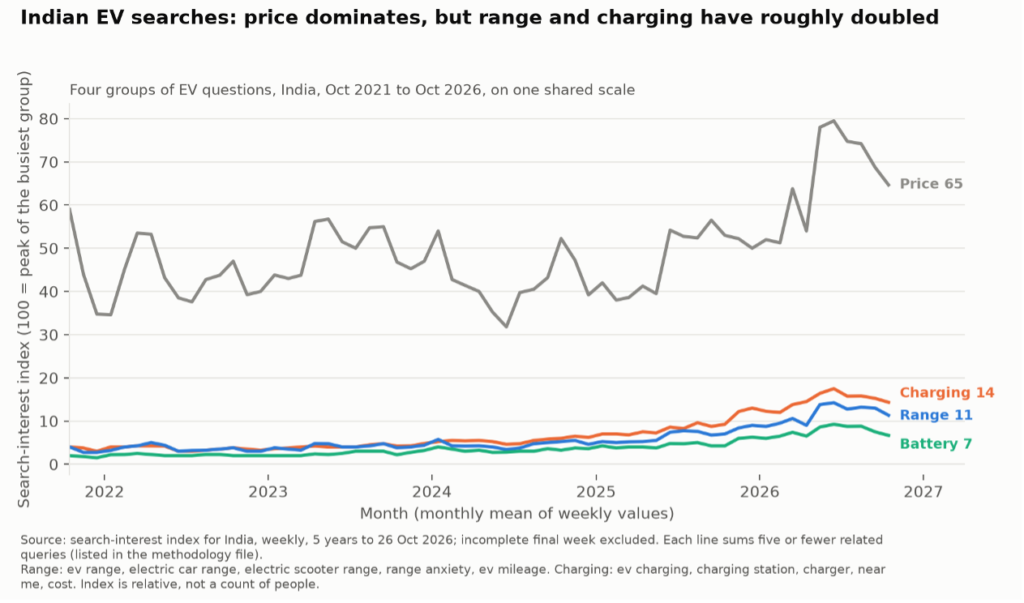
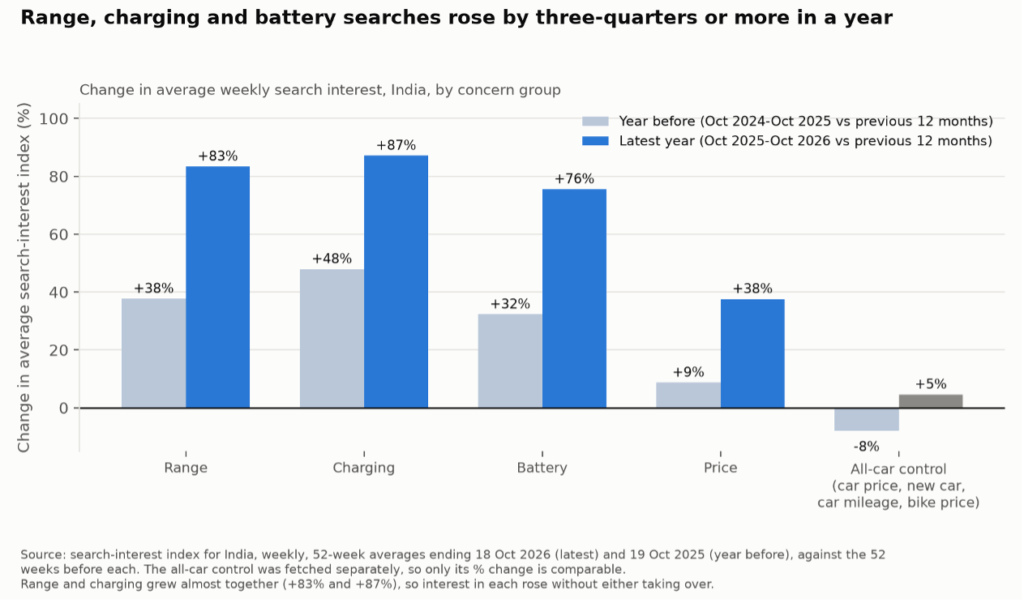
We grouped related Indian searches into four concerns: range, charging, price and battery. Over the 52 weeks to 18 October 2026, price searches averaged an index of 64, against 14 for charging, 11 for range and 7 for battery (Chart 1). Price is roughly six times range. But range grew 83% on the previous 52 weeks, charging 87%, battery 76% and price 38%. A control group of general car searches (car price, new car, car mileage, bike price) moved +5%. The year before, range had grown 38% and charging 48%, so the rise is accelerating, not settling.
Finding 2: The top 25 questions are about chargers and prices, and range appears through model names
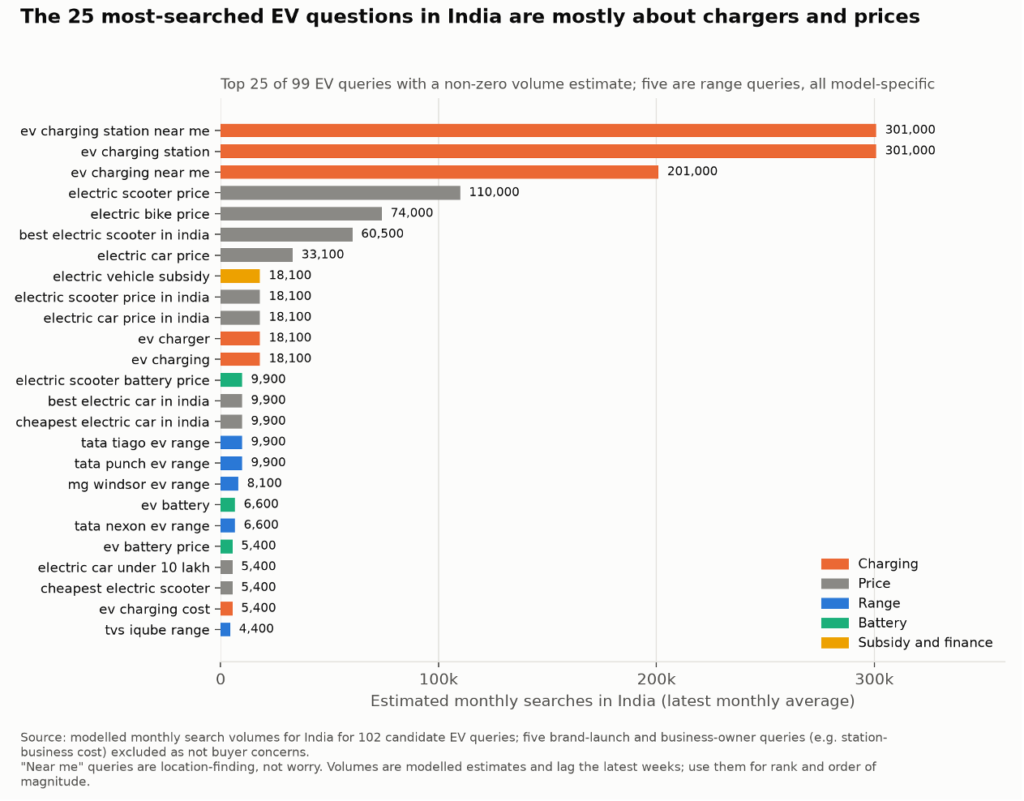
Of 99 EV queries with a non-zero modelled volume, the 25 largest draw about 1.27 million searches a month in India (Chart 2). Charging takes 67% of that, price 27%, range 3%, battery 2% and subsidies 1%. Part of the charging total is location-finding (“ev charging station near me”, 301,000 a month), which is a need to find a charger rather than a worry.
| Query | Monthly searches | Group | Interest, latest 52 weeks vs previous |
| ev charging station | 301,000 | Charging | +86% |
| electric scooter price | 110,000 | Price | +13% |
| electric vehicle subsidy | 18,100 | Subsidy | +46% |
| tata punch ev range | 9,900 | Range | +194% |
| tata tiago ev range | 9,900 | Range | +145% |
| mg windsor ev range | 8,100 | Range | +13% |
| tata nexon ev range | 6,600 | Range | +54% |
| tvs iqube range | 4,400 | Range | +37% |
Changes use each query’s own relative index, so small bases exaggerate percentages; read them as direction.
The five range queries in the top 25 all name a vehicle, and together they draw 38,900 searches a month. Generic phrases are far smaller: “electric scooter range” 1,600, “electric car range” 1,300, “ev mileage” 390, “ev range” 260 and “ev range anxiety” 40. The phrase “range anxiety” itself returned no measurable volume. For Indian buyers the worry shows up as a spec check on the model they are considering, not as a concept.
Finding 3: Is range fading relative to charging? Not in the way the headline suggests
Take range searches as a share of range plus charging searches. That share was 49.7% in 2022 and 49.0% in 2023, then fell to 45.3% in 2024 and 43.6% in 2025, and stands at 44.2% so far in 2026 (Chart 3, left). So charging has pulled slightly ahead since 2023, but the gap has been flat for about two and a half years. Both grew at nearly the same pace in the latest year (Chart 4), so neither is displacing the other.
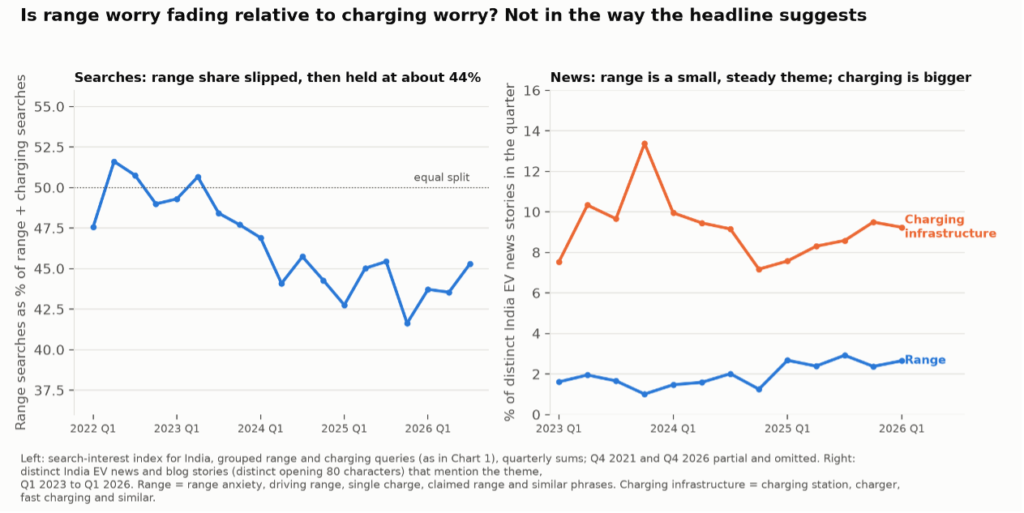
News coverage moved the other way (Chart 3, right). Between May 2024 to April 2025 and May 2025 to April 2026, the share of Indian EV stories about range rose from 2.0% to 2.9%, while the share about charging infrastructure was nearly flat, 8.2% to 8.8%. Range stories per 100 charging-infrastructure stories went from 24 to 33. “Range anxiety” as a phrase is rare in Indian EV news: 35 stories in the first year and 23 in the second, about 0.3% to 0.4% of the total.
Headlines and buyers also diverge on money. The subsidy share of EV news fell from 6.9% to 5.5%, yet searches for “electric vehicle subsidy” rose 46%. Charging infrastructure held a steady share of the news while charging searches nearly doubled. Coverage is following launches and companies; searchers are following their own decisions.
What the news is talking about: rising and falling themes
We compared two equal 12-month windows, 1 May 2024 to 30 April 2025 (9,138 distinct India EV stories) and 1 May 2025 to 30 April 2026 (6,961). The windows end in April because place labels, which tell us a story is about India, are not yet written for later months. For each theme we measured the share of stories that also carry the theme’s words in the lede or tags (Chart 5).
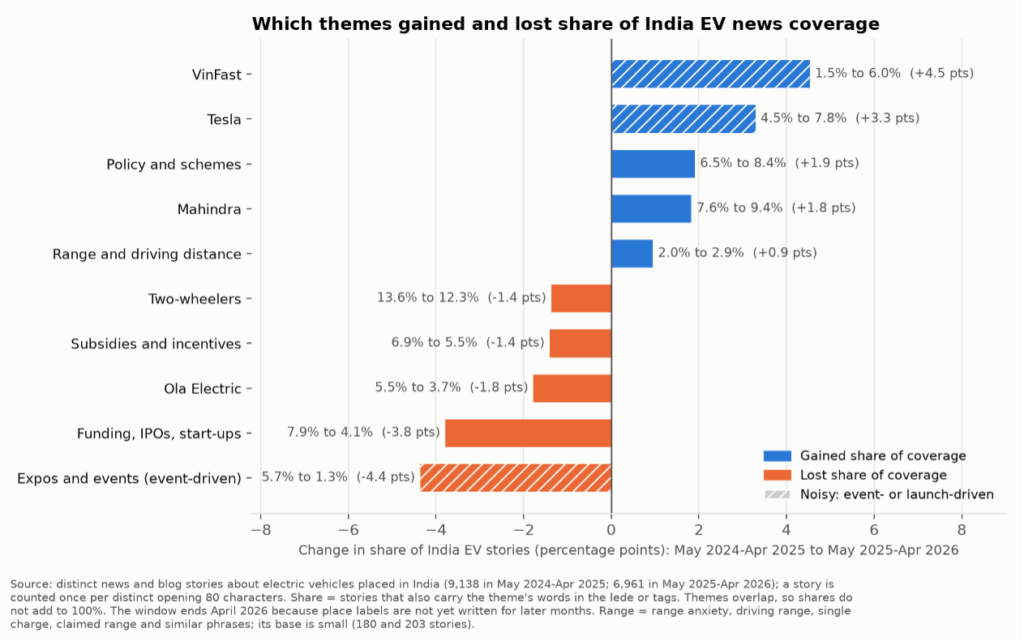
| Theme | What counts as the theme | Share, earlier window | Share, later window | Change |
| VinFast (noisy) | Stories naming VinFast | 1.5% | 6.0% | +4.5 pts |
| Tesla (noisy) | Stories naming Tesla | 4.5% | 7.8% | +3.3 pts |
| Policy and schemes | policy, scheme, mandate, regulation | 6.5% | 8.4% | +1.9 pts |
| Mahindra | Stories naming Mahindra | 7.6% | 9.4% | +1.8 pts |
| Range | range anxiety, driving range, single charge, claimed range and similar | 2.0% | 2.9% | +0.9 pts |
| Two-wheelers | two-wheeler, scooter, motorcycle | 13.6% | 12.3% | -1.4 pts |
| Subsidies and incentives | subsidy, FAME, PM E-DRIVE, incentive | 6.9% | 5.5% | -1.4 pts |
| Ola Electric | Stories naming Ola Electric | 5.5% | 3.7% | -1.8 pts |
| Funding, IPOs, start-ups | IPO, funding, raised, valuation, startup | 7.9% | 4.1% | -3.8 pts |
| Expos and events (noisy) | expo, auto show | 5.7% | 1.3% | -4.4 pts |
The rising themes are market entry and launches: VinFast and Tesla, whose coverage spiked in mid-2025, and Mahindra. The decliners are the finance and event strands, with funding, IPO and start-up coverage nearly halving and expos falling back after a January 2025 trade show that supplied 360 of the 518 expo stories in the earlier window. Of the four themes this article set out to track, range gained share, charging infrastructure held steady (8.2% to 8.8%), subsidies lost share, and battery safety stayed tiny (0.3% to 0.5%, 27 and 35 stories), too small to read.
How far to trust it. Themes overlap. Range and battery safety start from small bases. VinFast, Tesla and expos are event-driven, hatched in the chart, so their direction is clearer than their size. We also found a trap: counting every article, the price theme appeared to jump from 24% to 34%, but three months (April 2025, January 2026 and March 2026) carried large numbers of repeats of the same auto-generated car-listing page, one of them 1,374 times in April 2025. Counting each distinct story once, price is flat (11.6% to 11.7%). The count of labelled stories also fell 24%, partly because fewer recent articles carry a place label, so we compare shares, not counts.
Finding 4: Where range worry is strongest
Across states, the range share of range-plus-charging searches runs from 37% to 52% (map). It is highest in Bihar (52%), Odisha and Chhattisgarh (51%), and Madhya Pradesh and Jharkhand (50%), and lowest in Andhra Pradesh and Chandigarh (37%), Himachal Pradesh (38%), Nagaland (39%) and Puducherry (40%). The large metropolitan and southern states sit between 41% and 43%: Delhi 41%, Tamil Nadu 41%, Kerala 42%, Karnataka 42%, Maharashtra 43%.
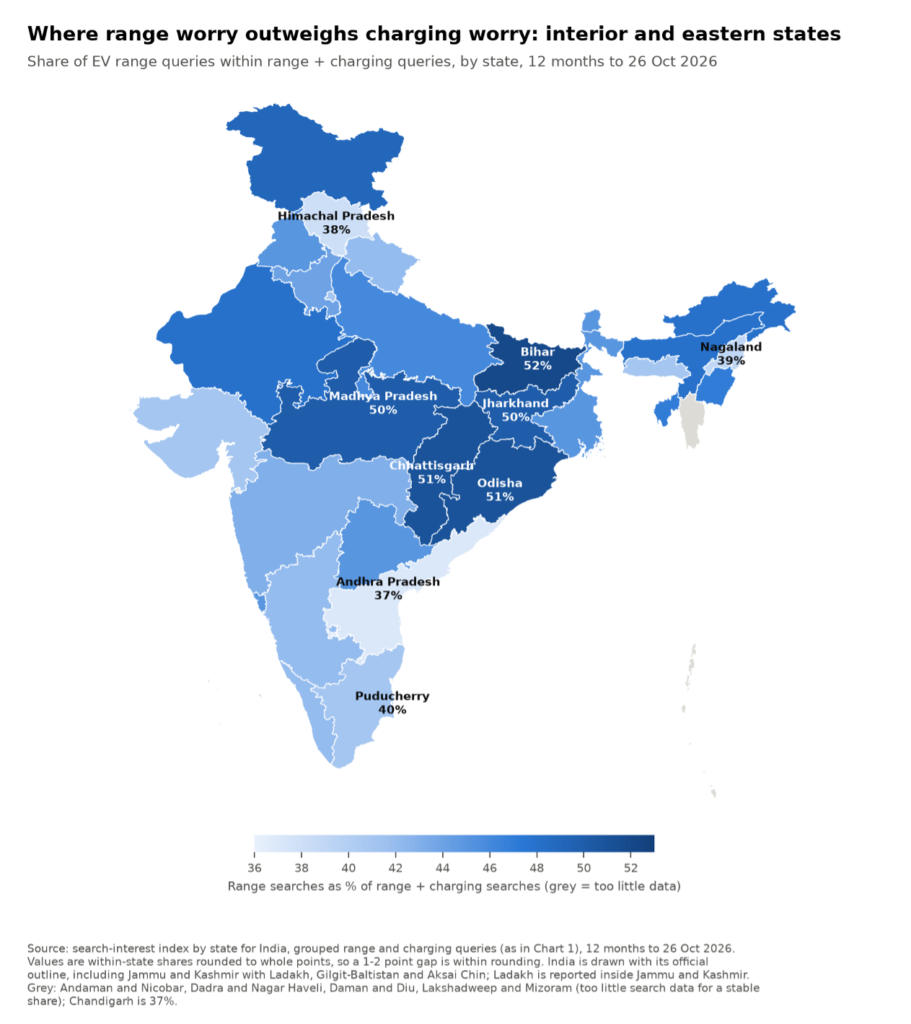
We expected range worry to be strongest where chargers are scarce. It is not. Across 31 states, installed public charging stations (29,151 nationally, of which 8,805 are fast, per a December 2025 Lok Sabha reply; Press Information Bureau, 2025) have a rank correlation of 0.03 with the range share. Counts are not adjusted for population or vehicle numbers, so this rules out a simple link, not a subtle one. In EV news, coverage concentrates in Maharashtra (1,206 stories in the latest 12 months), Delhi (1,031) and Karnataka (751). Delhi stands out for subsidies, at 13% of its stories against 5% in Maharashtra.
What it means
The 2027 answer from this evidence: range worry is not fading, but it is changing form. It is rising in absolute terms about as fast as charging worry, it is expressed as model-by-model range checks, and it sits slightly below charging in the mix. Charging is the bigger public conversation. The installed base has grown from 12,146 operational public stations on 2 February 2024 to 29,151 installed in the latest count, though the two figures use different definitions (Press Information Bureau, 2024b; 2025). More chargers may shift the mix, but searches show no sign yet that range concern is shrinking.
Method and limits
Search interest is a relative index for India, so percentages describe direction, not people. Index values for each concern group sum up to five related queries (listed in the methodology file) and are on one shared scale. Monthly volumes are modelled estimates for 102 queries we chose (99 returned a non-zero volume), so the intent shares describe that list, not all EV searching. State shares are rounded to whole points. News counts are distinct stories (distinct opening 80 characters) placed in India that mention “electric vehicle”, May 2024 to April 2026; the longer series runs from January 2023. No research-paper counts are reported: the paper-count queries timed out repeatedly during our run, so we left them out rather than estimate. We also found no usable source for EV range as measured against buyers’ real driving, so range claims were not tested. Charging-station counts are official ministry figures with different bases.
Data and analysis. The news, search and research-paper analysis in this article was run with Fliar Prism (Fliar Business Intelligence, 2026a), and the research tools it uses are published as the open-source Prism MCP (Fliar Business Intelligence, 2026b).
References
Baden, K.B. (2025) ‘More than just miles: range anxiety unplugged’, Transportation Research Part A: Policy and Practice, 200, 104661. https://doi.org/10.1016/j.tra.2025.104661
Fliar Business Intelligence (2026a) Fliar Prism: news, search and research-paper analysis [Data and analysis platform]. Available at: https://fliarbi.com/prism/ (Accessed: 27 October 2026).
Fliar Business Intelligence (2026b) Prism MCP: open-source research tools [Software]. GitHub. Available at: https://github.com/fliarbi/prism-mcp (Accessed: 27 October 2026).
Press Information Bureau (2024a) Cabinet approves PM Electric Drive Revolution in Innovative Vehicle Enhancement (PM E-DRIVE) Scheme with an outlay of Rs.10,900 crore over a period of two years, 11 September. Ministry of Heavy Industries, Government of India. https://www.pib.gov.in/PressReleasePage.aspx?PRID=2053889®=3&lang=2 (Accessed: 27 October 2026).