
Fuel prices across India’s metro cities continue to hold above Rs 100 per litre, and the case for hybrid ownership has never been stronger. The cheapest hybrid cars in India in 2026 span two fundamentally different technologies — mild hybrid and strong hybrid — and understanding that distinction is the first step toward choosing the right model for a specific budget and driving pattern. The 2026 market offers the widest affordable hybrid range India has ever seen, with entry-level options starting below Rs 10 lakh and strong hybrids available under Rs 20 lakh. This guide covers every major affordable hybrid model, their ARAI-certified mileage, real-world fuel savings, ownership costs, and a buyer’s checklist. Modern hybrids also pack connected car technology including OTA updates, remote diagnostics, and app-based controls that add long-term value well beyond fuel savings.
What Makes a Car a Hybrid — Mild Hybrid vs Strong Hybrid Explained
The two categories of hybrids sold in India differ significantly in how they use electric motor assistance and how much fuel they save.
A mild hybrid system — such as Maruti’s SHVS (Smart Hybrid Vehicle System) or a 48V ISG (Integrated Starter Generator) — adds a small electric motor to a conventional petrol engine. This motor assists during acceleration and recovers energy through regenerative braking, but it cannot propel the car on electricity alone. The result is a modest improvement in fuel efficiency of 8–12% over a comparable non-hybrid engine. Because mild hybrid technology uses a smaller battery and simpler power electronics, it costs less to engineer, which translates directly into a lower purchase price. These are the cheapest mild hybrid cars in India in absolute terms.
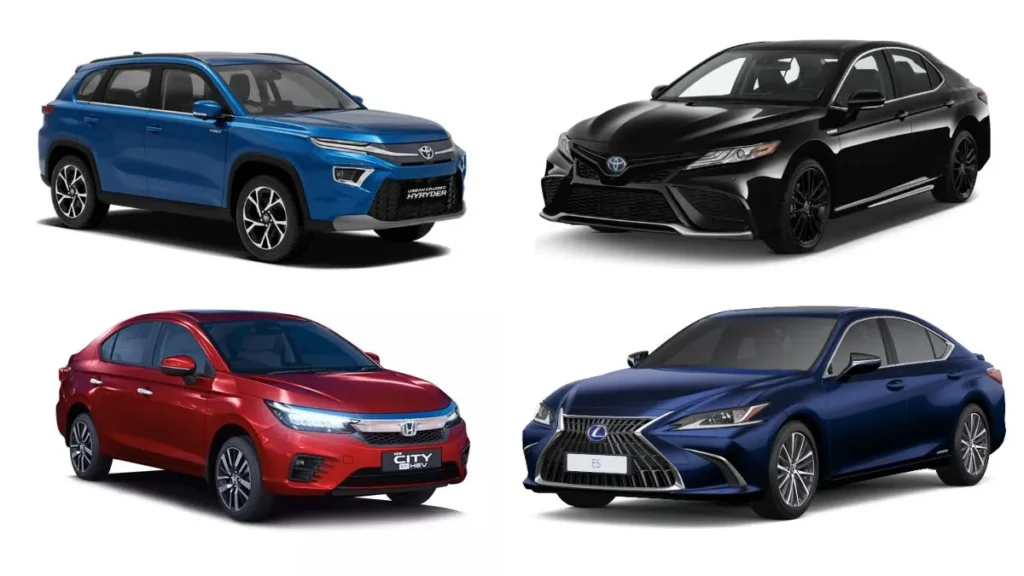
A strong hybrid system — such as Toyota’s THS (Toyota Hybrid System) used in the Grand Vitara and Hyryder, or Honda’s IMA-derived dual-motor system in the City e:HEV — pairs a larger electric motor with a self-charging hybrid battery capable of running the car in pure EV mode in city traffic. The petrol engine shuts off at low speeds and during braking, and the system relies on regenerative braking to replenish the battery without any external charging. Strong hybrids deliver 25–35% better fuel efficiency than equivalent non-hybrid petrol cars, with the gains most pronounced in stop-go city driving. They cost Rs 1.5–3 lakh more than the equivalent mild hybrid trim, but that premium is typically recovered through fuel savings within 3–5 years for a city-based buyer.
Understanding these two types shapes the decision: a buyer who drives mainly on highways may find mild hybrid technology a better value proposition. A city commuter clocking 1,200 km or more per month in heavy traffic extracts maximum return from a strong hybrid’s petrol-electric powertrain.
Cheapest Mild Hybrid Cars in India 2026 — Entry-Level Hybrid Buying Options
The cheapest hybrid cars in India 2026 that a buyer can walk into a showroom and purchase today are Maruti Suzuki mild hybrids. The India cheapest hybrid car models at the entry-level use the Smart Hybrid badge — a designation that covers Maruti’s SHVS technology across multiple platforms. These are the genuine hybrid cars under 10 lakh in India bracket, and they represent the most affordable path into hybrid ownership. All prices and mileage figures below are as of this writing — verify with Maruti Suzuki India or an authorised Arena/Nexa dealer before purchase, as prices are subject to revision.
Maruti Suzuki Fronx Smart Hybrid — Specs, Mileage and Price
The Maruti Suzuki Fronx Smart Hybrid pairs a 1.0-litre Boosterjet turbo-petrol engine with a 48V mild hybrid system. The SHVS unit assists the petrol engine during acceleration, reduces fuel cut-off delay, and recovers kinetic energy during braking. The certified mileage on the Fronx Smart Hybrid runs at approximately 21.5 kmpl across its manual variants (verify with Maruti Suzuki India, as figures are subject to revision). Ex-showroom pricing for Smart Hybrid variants spans approximately Rs 9.70 lakh for the Zeta MT through to Rs 11.98 lakh for the Alpha AT — figures that make it the entry point for mild hybrid technology in the Indian market. The Fronx suits urban buyers who want a stylish crossover with improved fuel efficiency without the strong hybrid premium. Its compact footprint and turbo response also make it a natural fit for buyers in Tier-2 cities where service centres are expanding rapidly.
Maruti Suzuki Ertiga Smart Hybrid — Specs, Mileage and Price
The Maruti Suzuki Ertiga Smart Hybrid is the most affordable 7-seater hybrid available in India. It uses the same SHVS architecture — Integrated Starter Generator plus Brake Energy Regeneration System — applied to its 1.5-litre K15C naturally aspirated petrol engine. The system provides torque assist during pull-away, reduces engine load at low speeds, and delivers improved fuel efficiency relative to the non-hybrid equivalent. Certified mileage across the Ertiga petrol-hybrid range runs at approximately 20.3–20.5 kmpl (manual and automatic variants respectively — verify with Maruti Suzuki India). Ex-showroom prices for the Ertiga Smart Hybrid range from approximately Rs 8.90 lakh to Rs 13.04 lakh across variants, as of this writing. The mild hybrid technology in Maruti’s lineup adds approximately Rs 50,000–80,000 over comparable non-hybrid trim levels — a premium that the improved mileage recoups comfortably over a 3-year ownership cycle for most city drivers. The Ertiga Smart Hybrid suits large families who need three-row seating at a price that undercuts any other hybrid MPV in India by a significant margin.
Cheapest Strong Hybrid Cars in India 2026 — Best Fuel Savers Worth the Premium
The cheapest strong hybrid cars in India in 2026 start from approximately Rs 17–18 lakh (ex-showroom, verify with dealer) and deliver a qualitatively different ownership experience from mild hybrids. The best affordable hybrid cars in India in this category run on a petrol-electric powertrain that prioritises city mileage above all else. These are the models that dominate the hybrid cars under 20 lakh in India bracket and account for the fastest-growing segment in Indian hybrid sales. All prices and mileage figures are as of this writing and subject to revision — verify with the respective manufacturer or authorised dealer before booking.
Maruti Suzuki Grand Vitara Strong Hybrid — Best Strong Hybrid SUV Under 20 Lakh
The Maruti Suzuki Grand Vitara strong hybrid is the most affordable TNGA-based strong hybrid SUV available in India. It uses Toyota’s 1.5-litre series-parallel hybrid system, paired with an e-CVT transmission that eliminates gear-shift interruptions and maximises electric-mode efficiency in city traffic. The Grand Vitara strong hybrid self-charging hybrid battery keeps itself topped up entirely through regenerative braking — no external charging required. Its ARAI-certified mileage of approximately 27.97 kmpl (verify with Maruti Suzuki India) makes it one of the most fuel-efficient SUVs ever sold in the Indian market. Ex-showroom pricing for strong hybrid variants of the Grand Vitara runs from approximately Rs 17 lakh to Rs 19.72 lakh (as of this writing, verify with dealer). A city-based driver covering 1,500 km per month can expect annual fuel savings of approximately Rs 40,000–55,000 over a 15 kmpl petrol car at current fuel rates (hedged: actual savings depend on fuel price at time of calculation and real-world driving pattern). The Grand Vitara strong hybrid represents the most accessible entry point into genuine strong hybrid technology packaged in an SUV body style.
Toyota Urban Cruiser Hyryder Strong Hybrid — Toyota’s Affordable Hybrid SUV
The Toyota Urban Cruiser Hyryder strong hybrid shares its TNGA hybrid architecture with the Grand Vitara — same 1.5-litre series-parallel system, same e-CVT transmission, same self-charging hybrid battery. Toyota’s version carries the same claimed mileage of approximately 27.97 kmpl and positions itself with slightly different variant configurations and feature sets from the Maruti equivalent. Post the 2026 price revision, the Hyryder strong hybrid V variant price rose by approximately Rs 42,700, with the full range now spanning approximately Rs 10.99 lakh to Rs 20.19 lakh across all trims (strong hybrid variants occupy the upper end — verify exact variant pricing with Toyota India). The Hyryder suits buyers who prefer Toyota’s service network and are comfortable with the brand premium over the equivalent Maruti variant. For those choosing between the two, the Hyryder G variant and the Grand Vitara Delta equivalent are the most direct comparisons.
Honda City e:HEV — Cheapest Strong Hybrid Sedan in India
The Honda City e:HEV is the only strong hybrid sedan available in India and the most affordable strong hybrid non-SUV available in the country. Its parallel hybrid system pairs a 1.5-litre Atkinson-cycle DOHC i-VTEC petrol engine with two electric motors — one for driving and one for regeneration — and a 0.784 kWh lithium-ion battery. The 2026 Honda City facelift e:HEV carries a claimed mileage of approximately 27.26 kmpl (as reported at launch — verify ARAI-certified figure with Honda India before purchase). The e:HEV is offered in top-spec variants, with the 2026 facelift City range starting at approximately Rs 11.99 lakh and the e:HEV variant positioned toward the higher end of the range (verify exact e:HEV pricing with Honda Cars India). The City e:HEV suits buyers who want strong hybrid fuel savings in a sedan form factor, with a mature 1.5-litre engine and dual-motor system that feels seamlessly integrated in city traffic.
Upcoming and Premium Affordable Hybrids — Maruti Victoris, Renault Duster and More
Beyond the established models, the best affordable hybrid cars in India landscape in late 2026 is expanding with new entrants. These are the models likely to define best mileage hybrid cars in India rankings over the next 12–18 months — but several are not yet launched as of this writing.
The Maruti Suzuki Victoris Strong Hybrid is expected to bring Toyota-sourced strong hybrid technology to the compact SUV segment, potentially at a price point below the Grand Vitara strong hybrid. As of this writing, the Victoris has not launched officially in India. All specifications and pricing attributed to it in any third-party report are unconfirmed estimates. Do not pre-book or pay any advance based on leaked specifications — wait for the official launch, ARAI-certified mileage, and confirmed dealer pricing before making any purchasing decision.
The Renault Duster E-Tech Hybrid arrives in India as a full hybrid mid-size SUV, using Renault’s proprietary E-Tech multi-mode hybrid system. The E-Tech system combines a 1.2-litre turbo-petrol engine with two electric motors and a dog-clutch gearbox designed to eliminate torque interruption. As of this writing, official India pricing and ARAI-certified mileage for the Duster E-Tech have not been confirmed — verify all specifications with Renault India before purchase.
For large-family buyers, the Maruti Suzuki Invicto and Toyota Innova Hycross Hybrid represent the premium end of the affordable strong hybrid range. Both use the same THS strong hybrid architecture in a larger 3-row MPV format, with mileage figures that make them the most fuel-efficient 7-seaters in India. Verify current pricing and variant details with respective dealers.
Cheapest Hybrid Cars in India — Side-by-Side Comparison Table
The cheapest hybrid cars in India 2026 span a wide price and technology range. The India cheapest hybrid car models from mild hybrid entry points to strong hybrid segment leaders are compared below. All prices are approximate ex-showroom values as of this writing — verify with manufacturers or authorised dealers before booking. ARAI mileage figures are certified values where confirmed; hedged estimates where ARAI data is not separately published.
| Model | Hybrid Type | Engine | ARAI Mileage* | Approx. Ex-showroom | Battery Warranty | Best For |
|---|---|---|---|---|---|---|
| Maruti Fronx Smart Hybrid | Mild Hybrid (48V) | 1.0L Turbo Boosterjet | ~21.5 kmpl | Rs 9.70–11.98 lakh | Standard car warranty | Urban buyers, style-first |
| Maruti Ertiga Smart Hybrid | Mild Hybrid (SHVS) | 1.5L K15C Petrol | ~20.3–20.5 kmpl | Rs 8.90–13.04 lakh | Standard car warranty | Large families, 7-seat MPV |
| Maruti Grand Vitara Strong Hybrid | Strong Hybrid | 1.5L TNGA + e-CVT | 27.97 kmpl | Rs ~17–19.72 lakh | 8 years / 1.6 lakh km | City commuters, SUV buyers |
| Toyota Hyryder Strong Hybrid | Strong Hybrid | 1.5L TNGA + e-CVT | 27.97 kmpl | Rs ~17–20.19 lakh | 8 years / 1.6 lakh km | Toyota loyalists, SUV buyers |
| Honda City e:HEV | Strong Hybrid | 1.5L Atkinson + dual motors | ~27.26 kmpl | Rs ~19–21 lakh | Verify with Honda India | Sedan buyers, highway + city |
| Maruti Victoris Strong Hybrid | Strong Hybrid (expected) | TBC | TBC | TBC | TBC | Compact SUV — not yet launched |
| Renault Duster E-Tech Hybrid | Full Hybrid (expected) | 1.2L Turbo + E-Tech | TBC | TBC | TBC | Mid-size SUV — confirm with Renault |
| Maruti Invicto Hybrid | Strong Hybrid | 2.0L TNGA + e-CVT | ~23.24 kmpl | Rs ~26–30 lakh | 8 years / 1.6 lakh km | Large families, 7-seat premium |
| Toyota Innova Hycross Hybrid | Strong Hybrid | 2.0L TNGA + e-CVT | ~21.1 kmpl | Rs ~19–29 lakh | 8 years / 1.6 lakh km | Large families, premium MPV |
*All mileage figures ARAI-certified or manufacturer-claimed as of this writing. Verify before purchase. TBC = To Be Confirmed at official launch.
The break-even calculation for strong versus mild hybrid is straightforward: a Grand Vitara strong hybrid at approximately Rs 17 lakh costs roughly Rs 2–3 lakh more than a comparable Grand Vitara mild hybrid variant. At a fuel saving of Rs 3,500–4,500 per month (city driving, 1,500 km/month at Rs 105/litre, 27.97 kmpl versus 19.5 kmpl), the premium pays back in approximately 3–4 years. City-dominant drivers with high monthly mileage tip this calculation in favour of the strong hybrid earlier.
Hybrid Vehicle Ownership Cost in India — Fuel Savings, Battery Warranty and Maintenance
The most common concern Indian buyers raise about best mileage hybrid cars in India models is total cost of ownership — specifically, whether the upfront premium over a standard petrol car is justified over a 5-year holding period. The answer breaks cleanly into three components.
Fuel savings: A city-based driver covering 1,500 km per month in a strong hybrid averaging 23 kmpl real-world (down from 27.97 kmpl ARAI, accounting for Indian traffic conditions) spends approximately Rs 6,850 per month on petrol at Rs 105/litre. The same driver in a 15 kmpl petrol car spends approximately Rs 10,500 per month. That is a saving of approximately Rs 3,650 per month, or Rs 43,800 per year (all figures hedged — verify current fuel price in your city and use your own consumption data for an accurate projection). Over five years, the total saving approaches Rs 2.19 lakh — which covers a significant portion of the strong hybrid premium.
Hybrid battery warranty: Maruti and Toyota both cover their strong hybrid battery packs for 8 years or 1.60 lakh kilometres, whichever comes first. This is the most direct de-risking mechanism for a buyer concerned about battery replacement cost. For the ARAI India certification methodology on fuel efficiency testing and what the certified figures represent in controlled conditions, the ARAI portal provides the full testing protocol as a public reference. Honda City e:HEV battery warranty terms should be verified directly with Honda Cars India before purchase, as terms may differ from Toyota/Maruti.
Maintenance: Strong hybrids carry several built-in maintenance advantages. Regenerative braking reduces mechanical brake pad wear significantly — owners of Toyota’s strong hybrid systems typically report 30–50% longer brake pad life than comparable petrol cars (actual wear depends on driving style and traffic pattern). Strong hybrids also replace the conventional alternator with an integrated motor-generator, eliminating a component that is a common maintenance item in conventional cars. Hybrid-specific servicing must be performed at authorised service centres by trained technicians — independent garage servicing is not recommended for hybrid battery or motor-related work. Maintenance costs vary by usage pattern, city, and service centre — consult your dealer for a full TCO estimate specific to your situation.
6 Smart Tips for Buying the Cheapest Hybrid Car in India
Tip 1 — Choose hybrid type based on driving pattern, not headline mileage. City commuters with heavy stop-go traffic extract maximum value from a strong hybrid. The regenerative braking cycle keeps the self-charging hybrid battery topped up continuously in bumper-to-bumper traffic, which is exactly the condition where petrol engines are least efficient. Highway-dominant drivers see smaller gains from strong hybrids because the combustion engine is already operating at its efficient cruise rpm. For them, the cheapest hybrid cars in India in the mild hybrid bracket offer better cost-to-benefit ratio.
Tip 2 — Always verify ARAI-certified mileage against real-world owner reports. ARAI figures are tested under controlled laboratory conditions with no AC load, standardised speed cycles, and optimal tyre pressures. Indian real-world mileage for strong hybrids typically runs 15–20% lower than ARAI figures in mixed urban-highway usage. Buyers should anchor expectations on owner community data from automotive forums and owner reviews, treating ARAI numbers as a comparative benchmark rather than a delivery promise.
Tip 3 — Factor hybrid battery warranty into the total cost of ownership calculation. The 8-year/1.6 lakh km hybrid battery warranty offered by Maruti and Toyota materially reduces the financial risk of hybrid ownership for most buyers — the majority of Indian car owners change vehicles within 7 years. Honda City e:HEV buyers should confirm warranty terms with Honda India directly. A stronger battery warranty represents a lower hidden cost over the ownership period.
Tip 4 — Get an on-road price quote, not just the ex-showroom figure. On-road price adds GST, registration charges, insurance, and optional accessories — it typically runs 10–15% above ex-showroom. Hybrid models pay a 28% GST rate plus cess (same as conventional petrol cars), compared to 5% for EVs. This makes the on-road gap meaningful, particularly for strong hybrid models priced above Rs 15 lakh. Always request a full itemised on-road breakdown from the dealer before comparing models.
Tip 5 — Compare variant-level equipment before choosing mild versus strong hybrid. In the Grand Vitara lineup, the strong hybrid powertrain is offered in a limited set of variant configurations — not every trim level carries the strong hybrid option. Confirm that the available strong hybrid trim includes the features that matter most: panoramic sunroof, ventilated seats, ADAS suite, and connected car technology. The cheapest strong hybrid trim is a mid-spec vehicle, not a fully loaded one.
Tip 6 — Avoid pre-booking upcoming hybrid models without confirmed specification sheets. The Maruti Victoris Strong Hybrid and Renault Duster E-Tech Hybrid have not been officially launched in India as of this writing. Third-party estimates, leaked specifications, and social media previews do not constitute confirmed data. Wait for the official launch event with published ARAI-certified mileage, confirmed warranty terms, and an authorised dealer quote before committing any advance amount.
FAQ — People Also Ask About Cheapest Hybrid Cars in India
Q1: Which is the cheapest hybrid car in India in 2026?
The Maruti Suzuki Ertiga Smart Hybrid is the cheapest hybrid car in India in 2026 by ex-showroom starting price, with entry variants available from approximately Rs 8.90 lakh (verify with Maruti Arena before purchase). For the cheapest mild hybrid in a crossover body style, the Maruti Suzuki Fronx Smart Hybrid starts from approximately Rs 9.70 lakh. The cheapest strong hybrid car in India is the Maruti Suzuki Grand Vitara strong hybrid, starting from approximately Rs 17 lakh ex-showroom. The choice between these depends entirely on whether the buyer prioritises the entry price or long-term fuel savings.
Q2: Is a hybrid car worth buying in India?
A hybrid car delivers its strongest value case for city-dominant buyers who drive 1,000 km or more per month in stop-go urban traffic. The self-charging hybrid battery requires no external charging, eliminating the range and charging anxiety associated with plug-in hybrids and EVs. Strong hybrids from Maruti and Toyota return fuel savings of Rs 35,000–50,000 per year for city-based users (hedged: depends on fuel price and actual usage). The 8-year battery warranty substantially de-risks the ownership experience. For highway-dominant drivers, the mild hybrid models offer a better cost-to-benefit ratio and lower entry price.
Q3: What is the difference between mild hybrid and strong hybrid cars?
A mild hybrid adds a small electric motor that assists the petrol engine during acceleration and recovers energy through regenerative braking — it cannot drive on electricity alone. A strong hybrid uses a larger electric motor and a self-charging hybrid battery that enables the car to run in pure EV mode in city traffic, with the petrol engine switching off at low speeds. Strong hybrids deliver 25–35% better fuel efficiency but cost Rs 1.5–3 lakh more. Mild hybrid technology adds 8–12% fuel efficiency at a lower purchase premium. The choice depends on budget, monthly mileage, and driving conditions.
Q4: Do hybrid cars require special maintenance in India?
Hybrid cars must be serviced at authorised service centres — the hybrid battery, motor-generator, and power electronics require trained technicians and OEM-specific diagnostic tools that independent garages do not carry. Routine maintenance (engine oil, air filter, tyres) follows the same schedule as a conventional petrol car. Regenerative braking reduces brake pad wear by 30–50%, lowering that specific maintenance cost over time. The hybrid battery is sealed and self-regulating — there is no topping-up or external maintenance required during normal ownership. Maruti and Toyota’s 8-year/1.60 lakh km hybrid battery warranty covers battery-related failures.
Q5: Which hybrid car gives the best mileage in India?
The best mileage hybrid cars in India are the Maruti Suzuki Grand Vitara and Toyota Urban Cruiser Hyryder, both returning an ARAI-certified 27.97 kmpl on their strong hybrid variants (verify figures with respective manufacturers). The Honda City e:HEV follows at approximately 27.26 kmpl (manufacturer-claimed for the 2026 facelift — verify ARAI certification with Honda India). Real-world city mileage for all three models typically lands in the 20–24 kmpl range depending on traffic conditions and AC usage. All strong hybrids significantly outperform their mild hybrid counterparts, which return 20–22 kmpl under ARAI conditions.
Cheapest Hybrid Cars in India 2026 — The Right Pick Depends on How and Where You Drive
The cheapest hybrid cars in India do not come with a single correct answer — the right model depends on budget, body style preference, and driving pattern. Buyers with a budget under Rs 12 lakh should start with the Maruti Suzuki Ertiga Smart Hybrid for 7-seat capacity or the Maruti Suzuki Fronx Smart Hybrid for a crossover with mild hybrid fuel efficiency. Both deliver genuine ownership value at accessible price points.
Buyers with a budget of Rs 15–20 lakh and a city-heavy driving pattern should strongly consider the Maruti Suzuki Grand Vitara or Toyota Urban Cruiser Hyryder strong hybrid. The fuel savings at high monthly mileage make the premium over mild hybrid genuinely worthwhile, and the 8-year battery warranty removes the primary long-term ownership risk. For sedan buyers, the Honda City e:HEV is the only strong hybrid sedan in India and the natural choice for those who prefer a 3-box form factor over an SUV.
Large families who need 7-seat capacity with strong hybrid efficiency should evaluate the Maruti Invicto and Toyota Innova Hycross Hybrid at the premium end of the affordable hybrid space. For upcoming models — the Maruti Victoris and Renault Duster E-Tech — the guidance is straightforward: wait for the official India launch, confirmed ARAI figures, and published warranty terms before making any purchase decision. Verify all prices, mileage, and warranty terms with authorised dealers before booking, as specifications and pricing remain subject to revision without prior notice.