
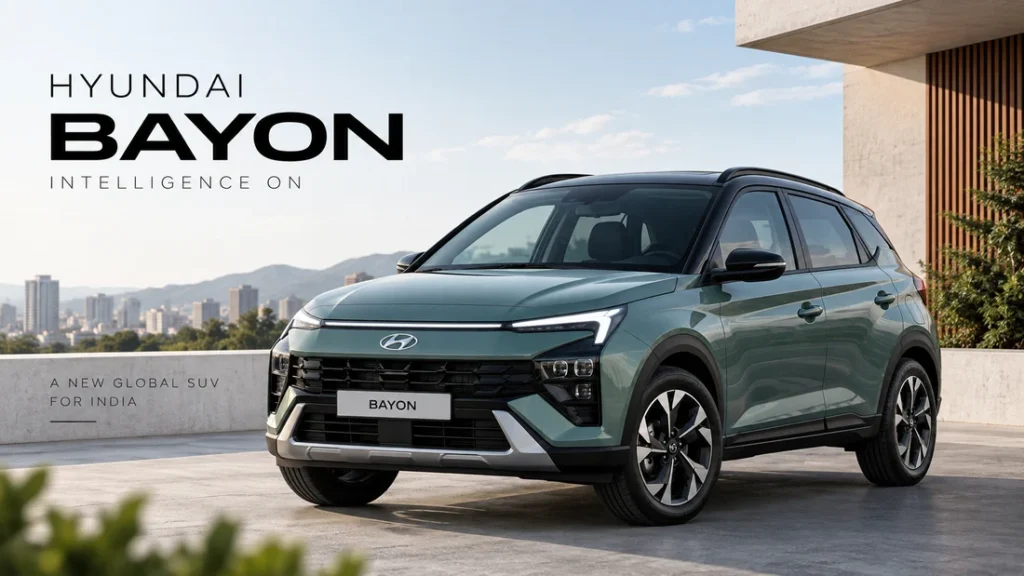
The Hyundai Bayon CNG is set to enter India’s factory-fitted CNG SUV segment in January 2027 — a space currently dominated by the Maruti Victoris CNG and Grand Vitara CNG. Hyundai has officially confirmed the January 2027 launch. Early reports suggest the Bayon CNG will carry an underbody CNG tank that keeps the full boot intact, a feature no rival currently offers. This article covers the confirmed launch timeline, expected pricing, engine specifications, mileage estimates, and a head-to-head comparison — everything an Indian buyer needs before the launch event.
Hyundai Bayon CNG India — What Is It and When Is It Launching?
Hyundai officially confirmed the Hyundai Bayon CNG launch date in India as January 2027, making it the brand’s first factory-fitted CNG passenger SUV in the country. The Bayon petrol launched in October 2026 at Rs 9.99 lakh (ex-showroom); the CNG variant rides the same Global K Enhanced Platform and carries the same exterior body, adding a parallel fuel system tuned and certified at the factory.
The Hyundai Bayon CNG January 2027 launch positions Hyundai directly against Maruti Suzuki, which currently controls the factory-fitted CNG SUV space through the Victoris CNG and Grand Vitara CNG. Toyota’s Urban Cruiser Hyryder CNG completes the competitive set. The Bayon CNG will be the first Hyundai product to deploy an underbody CNG tank layout in India — as per current reports — a meaningful structural difference from every competitor in this segment.
Exact launch timing within January 2027 has not been announced. An Auto Expo 2027 reveal or a standalone Hyundai India event before the end of January remains the most likely scenario.
Hyundai HY-CNG Technology — What Makes It Different from Aftermarket Kits
Hyundai’s HY-CNG technology refers to the brand’s factory-engineered approach to CNG integration, distinct from the aftermarket kits that many Indian buyers retrofit onto petrol cars. The key differences matter in daily ownership.
A factory-fitted CNG system tunes the ECU from the ground up for dual-fuel petrol and CNG system operation — fuel mapping, injection timing, and idle management are calibrated for both fuels simultaneously rather than patched over a petrol-only system. The factory CNG system falls under the standard Hyundai warranty, covering parts and repairs through the dealer network. Aftermarket kits carry no manufacturer warranty and void the petrol powertrain warranty in most cases.
The most discussed feature of the Bayon CNG is the expected underbody CNG tank. If confirmed at launch, the tank mounts beneath the chassis rather than inside the boot floor — matching the Victoris CNG’s approach and contrasting with the Grand Vitara CNG and Hyryder CNG, which mount the tank in the boot. This placement directly affects usable cargo volume, covered in detail in H2 #5. The underbody tank placement is reported across multiple sources but remains unconfirmed until the official January 2027 launch announcement.
The Bayon CNG also integrates Hyundai’s connected car technology through the BlueLink platform, which operates identically on the CNG variant with remote monitoring, trip analytics, and fuel consumption tracking across both petrol and CNG operation.
Hyundai Bayon CNG Price in India — Expected Variant-Wise Pricing
No official Hyundai Bayon CNG price in India has been announced as of October 2026. Based on the CNG premium Hyundai applies across its existing CNG cars — the Aura CNG and i20 CNG — buyers can expect a premium of approximately Rs 90,000 to Rs 1,00,000 over the equivalent petrol trim.
The Bayon petrol range runs from Rs 9.99 lakh (ex-showroom) for the base trim to Rs 17.50 lakh for the top trim. Using the Rs 90,000–1,00,000 CNG uplift as the reference:
| Bayon Petrol Variant | Petrol Ex-Showroom (Oct 2026) | Estimated CNG Ex-Showroom |
|---|---|---|
| HX2 MT (base) | Rs 9.99 lakh | Rs 10.89–10.99 lakh (est.) |
| HX4 MT | Rs 11.XX lakh (approx.) | Rs 12.XX lakh (est.) |
| HX6 MT | Rs 13.XX lakh (approx.) | Rs 14.XX lakh (est.) |
| HX8 MT | Rs 15.XX lakh (approx.) | Rs 16.XX lakh (est.) |
All CNG prices are estimates derived from the typical Hyundai CNG premium. Hyundai India has not confirmed CNG prices. Verify at launch.
On-road prices will add registration charges, road tax, and insurance — typically 10–13% above the ex-showroom figure, varying by city and state.
Which Variants Will Get the CNG Option?
Hyundai has not announced the Hyundai Bayon CNG variants and price lineup. Based on the brand’s prior CNG launches — Aura CNG, i20 CNG, Venue CNG — Hyundai typically limits CNG availability to mid-range trims, skipping the base and top-spec variants.
On the Bayon, this pattern suggests the HX2 (base) may not receive CNG, and the top HX10 trim may also be excluded. Mid-range trims — HX4 through HX8 — appear most likely to carry the CNG option.
The six-speed manual gearbox is the expected transmission for all CNG variants. Every Hyundai CNG car currently sold in India uses a manual gearbox only; the iVT CVT automatic has not been offered with CNG on any Hyundai model. Buyers who need an automatic should plan on the petrol iVT variant and confirm at the January 2027 launch whether any exception exists for the Bayon.
Hyundai Bayon CNG Engine Specifications and Performance
The Hyundai Bayon CNG engine specifications are expected to use the same 1.5-litre petrol engine as the standard Bayon — a naturally aspirated four-cylinder engine producing 115 PS and 144 Nm in petrol mode. In CNG mode, power output drops by approximately 8–12%, which is standard across all factory CNG cars. No Hyundai-confirmed CNG output figures exist as of October 2026; expect approximately 100–106 PS in CNG mode based on the petrol baseline.
The six-speed manual gearbox carries over from the petrol manual variants. ARAI-certified figures for the CNG engine will be published at or before the January 2027 launch — buyers should wait for official figures rather than estimates for any purchase decision.
The Hyundai Bayon petrol mileage is rated at 18.6 kmpl (ARAI) for the manual petrol variant. CNG operation will improve running cost significantly at the expense of a modest power reduction.
Petrol Mode vs CNG Mode — How the Dual-Fuel System Works
The dual-fuel petrol and CNG system on Hyundai CNG cars operates through a dashboard-mounted push-button toggle. The engine starts on petrol and switches to CNG automatically after approximately 10–15 seconds, once the engine reaches operating temperature and the CNG system pressurises correctly. The driver can also switch back to petrol at any point using the same button.
When the CNG tank empties, the system switches to petrol automatically without driver intervention, preventing a roadside fuel situation. The petrol tank carries a standard reserve, functioning as the backup fuel source across all driving scenarios. This seamless two-fuel operation is a core advantage of the factory CNG system over aftermarket conversions, which require manual fuel switching and lack automatic failover logic.
Hyundai Bayon CNG Mileage — What to Expect Per Kg

The Hyundai Bayon CNG mileage per kg has not been officially stated. Based on comparable Hyundai CNG models and the petrol engine baseline, the estimated ARAI claim sits in the range of 25–28 km/kg. Daily Jagran’s pre-launch report cites 25–28 km/kg as the expected figure; this remains unconfirmed until Hyundai India publishes ARAI certification data at launch.
Real-world CNG fuel efficiency on comparable cars — Aura CNG, i20 CNG — typically runs 15–20% below the ARAI claim in city-heavy Indian driving. A realistic daily-use figure of 20–22 km/kg is a reasonable expectation for mixed urban and highway driving in cities like Delhi, Mumbai, and Pune.
CNG running cost per kilometre: At Delhi CNG prices of approximately Rs 75–78 per kg (October 2026), and an assumed 22 km/kg real-world figure, the running cost works out to approximately Rs 3.4–3.5 per km. The Bayon petrol at 14–16 km/l real-world and petrol prices of approximately Rs 96 per litre (Delhi) delivers a running cost of approximately Rs 6.0–6.9 per km.
CNG Running Cost vs Petrol — Monthly Savings Calculator
Base assumption: 1,500 km/month, Delhi fuel prices (October 2026 estimates)
| Parameter | CNG Mode | Petrol Mode |
|---|---|---|
| Fuel price | Rs 76/kg (est.) | Rs 96/litre (approx.) |
| Real-world efficiency | 22 km/kg (est.) | 15 km/l (est.) |
| Cost per km | Rs 3.45 | Rs 6.40 |
| Monthly fuel cost (1,500 km) | Rs 5,175 | Rs 9,600 |
| Monthly saving | Rs 4,425 | — |
| Annual saving | Rs 53,100 | — |
Fuel prices vary by city and change monthly. Recalculate using local CNG pump prices for an accurate payback projection.
At Rs 53,100 annual savings, the expected Rs 90,000–1,00,000 CNG premium pays back in 20–22 months — a reasonable break-even for an affordable running-cost SUV that will be driven primarily in city traffic.
Hyundai Bayon CNG Boot Space — Does the Tank Affect Practicality?
The Hyundai Bayon CNG boot space question is the most practically important for family buyers. The standard Bayon petrol offers 505 litres of boot volume — among the largest figures in the sub-compact SUV segment.
If the underbody CNG tank is confirmed at launch, the petrol boot volume of 505 litres carries over to the CNG variant unchanged. The tank sits beneath the chassis floor rather than intruding into the cargo area. This is the same approach Maruti uses on the Victoris CNG — which retains a larger boot than the Grand Vitara CNG and Hyryder CNG, both of which mount the tank inside the boot floor and sacrifice cargo volume.
The SUV boot space advantage of an underbody tank layout becomes clear in the comparison table in H2 #6. Until Hyundai confirms the tank placement at the January 2027 launch, buyers should treat the 505-litre figure as unconfirmed for the CNG variant.
On spare tyre arrangement: factory CNG SUVs in India typically replace the spare wheel with a tyre inflation kit (puncture repair canister) to accommodate the CNG tank and preserve space. Whether the Bayon CNG will carry a spare wheel or a puncture kit has not been confirmed by Hyundai India.
Hyundai Bayon CNG vs Maruti Victoris CNG — How Do They Compare?
The Hyundai Bayon CNG vs Maruti Victoris CNG comparison is the clearest lens through which to evaluate both cars. The Victoris CNG is currently on sale with confirmed pricing; Bayon CNG figures carry pre-launch hedging. According to Cartoq’s confirmed Victoris CNG comparison data, the Victoris CNG LXi starts at Rs 11.49 lakh (ex-showroom).
| Parameter | Hyundai Bayon CNG (Expected) | Maruti Victoris CNG | Maruti Grand Vitara CNG | Toyota Hyryder CNG |
|---|---|---|---|---|
| Starting price (ex-sh) | Rs 10.89 lakh (est.) | Rs 11.49 lakh (confirmed) | Rs 12.99 lakh (confirmed) | Rs 13.33 lakh (confirmed) |
| Engine | 1.5L NA, 4-cyl | 1.5L NA, 4-cyl | 1.5L NA, 4-cyl | 1.5L NA, 4-cyl |
| CNG mileage | 25–28 km/kg (est.) | 27 km/kg (official) | 26 km/kg (official) | 26.6 km/kg (official) |
| CNG tank placement | Underbody (expected) | Underbody (confirmed) | Boot-mounted | Boot-mounted |
| Boot space (CNG) | 505L (if underbody) | Larger than rivals | Reduced | 373L |
| Gearbox | 6-speed MT (expected) | 5-speed MT | 5-speed MT | 5-speed MT |
| ADAS | SmartSense L2 (expected) | Not available | Not available | Not available |
| Factory CNG warranty | Yes | Yes | Yes | Yes |
Bayon CNG figures marked “expected” are pre-launch estimates. Confirmed figures sourced from Cartoq, Carlelo, and Autocar India (October 2026).
The Maruti Suzuki Victoris CNG and Maruti Grand Vitara CNG share the same 1.5L K15C engine producing 86 bhp in CNG mode. The Toyota Urban Cruiser Hyryder CNG uses the same mechanicals, sourced from the Maruti platform. None of the three offer ADAS. If the Bayon CNG delivers SmartSense Level 2 ADAS on CNG trims — a feature not yet confirmed but consistent with the petrol variant’s offering — it will be the only factory-fitted CNG SUV in this segment with driver assistance technology.
Tips for Hyundai Bayon CNG Buyers
Tip 1 — Wait for the official January 2027 announcement before booking. Dealer-confirmed prices before an official launch often differ from the published ex-showroom figures. Multiple buyers on forum discussions have reported paying Rs 5,000–15,000 above ex-showroom on pre-launch bookings that were later corrected. Wait for Hyundai India’s official pricing announcement, then book.
Tip 2 — Prioritise ADAS-equipped trims if available on CNG variants. The Bayon petrol’s SmartSense suite — Forward Collision Avoidance, Lane Keep Assist, Blind Spot Collision Warning, and Rear Cross-Traffic Collision Avoidance — is not available on any competing CNG SUV. If Hyundai extends SmartSense to CNG trims, paying the trim premium for ADAS access is strongly justified. No other factory CNG SUV in this segment offers it.
Tip 3 — Confirm CNG tank placement at the dealership test drive. An underbody tank preserves the 505-litre boot; a boot-mounted tank reduces cargo volume substantially. This is not a minor point — it changes whether the car works for a family with weekend luggage or school run bags. Drive the car, open the boot, and see the actual usable space before booking.
Tip 4 — Calculate the CNG premium payback at your city’s fuel prices. The Rs 90,000–1,00,000 CNG premium over the petrol variant pays back in approximately 20–22 months at Delhi fuel prices and 1,500 km/month. CNG prices vary significantly by city — Mumbai, Pune, and Ahmedabad CNG rates differ from Delhi. Recalculate using your city’s live CNG price for a personalised break-even figure before choosing between the petrol and CNG variants.
Tip 5 — Confirm gearbox options before visiting the showroom. Every Hyundai CNG car currently available — Aura, i20, Venue — comes exclusively with a manual gearbox. The six-speed manual gearbox is the expected transmission for the Bayon CNG. Buyers who prefer an automatic should confirm at the showroom whether the iVT CVT has been extended to the CNG variants. Arriving with this question saves time in the showroom conversation.
FAQ — People Also Ask About the Hyundai Bayon CNG
Q1. What is the expected Hyundai Bayon CNG launch date in India?
Hyundai has officially confirmed the Hyundai Bayon CNG launch date in India as January 2027. The exact date within January has not been announced. An Auto Expo 2027 reveal or a standalone Hyundai India launch event before the end of January 2027 is the most likely timing. Buyers can register interest through the Hyundai India website to receive official communication when pricing is confirmed.
Q2. What will be the Hyundai Bayon CNG price in India?
No official Hyundai Bayon CNG price in India has been announced. Based on Hyundai’s CNG pricing precedent (Aura, i20, Venue), the CNG variants are expected to carry a premium of Rs 90,000–1,00,000 over the equivalent petrol trim. With the petrol Bayon starting at Rs 9.99 lakh, the CNG starting price is estimated at approximately Rs 10.89–10.99 lakh (ex-showroom). These are estimates; confirm with Hyundai India at the January 2027 launch.
Q3. How many km per kg will the Hyundai Bayon CNG give?
The Hyundai Bayon CNG mileage per kg is estimated at 25–28 km/kg (ARAI, unconfirmed). The Victoris CNG delivers 27 km/kg officially; the Grand Vitara CNG claims 26 km/kg. Real-world CNG fuel efficiency on comparable cars runs 15–20% below ARAI in city driving, placing practical daily-use mileage at approximately 20–22 km/kg. Official ARAI figures will be published at the January 2027 launch.
Q4. Does the Hyundai Bayon CNG have a full boot or is space reduced?
The Hyundai Bayon CNG boot space depends on the CNG tank placement. Multiple pre-launch reports suggest an underbody CNG tank — which would preserve the petrol variant’s 505-litre boot unchanged. Competitors the Grand Vitara CNG and Hyryder CNG (373L) use boot-mounted tanks, reducing usable cargo space. Tank placement is not officially confirmed; verify at the dealership when the CNG variant arrives.
Q5. How does the Hyundai Bayon CNG compare with the Maruti Victoris CNG?
The Hyundai Bayon CNG vs Maruti Victoris CNG comparison favours the Bayon on two expected grounds: a six-speed manual (vs Victoris’s five-speed) and the anticipated addition of SmartSense Level 2 ADAS — unavailable on the Victoris CNG. The Victoris CNG has the advantage of confirmed pricing (starting Rs 11.49 lakh) and current availability. The full comparison table in this article covers pricing, mileage, tank type, boot space, gearbox, and ADAS across all four major competitors.
Conclusion — Should You Wait for the Hyundai Bayon CNG?
The case for waiting is straightforward: if Hyundai delivers the underbody CNG tank and extends SmartSense ADAS to CNG trims, the Hyundai Bayon CNG will offer something no competitor in the factory-fitted CNG SUV space currently provides. Full boot space, Level 2 driver assistance, a factory warranty, and competitive mileage in one sub-compact SUV — that combination does not exist today.
The case against waiting is equally clear: the Bayon CNG does not yet exist. Buyers with an immediate need for a CNG SUV should not wait until January 2027. The Victoris CNG at Rs 11.49 lakh (ex-showroom) and the Grand Vitara CNG at Rs 12.99 lakh are proven, in-stock products with confirmed mileage and dealer support today.
For buyers who can wait three months and want the most capable factory CNG SUV in this segment, the Hyundai Bayon CNG deserves serious evaluation at the January 2027 launch. Monitor the official Hyundai India announcement for pricing, variant lineup, and the tank placement confirmation — those three data points will determine whether the wait was worthwhile.