
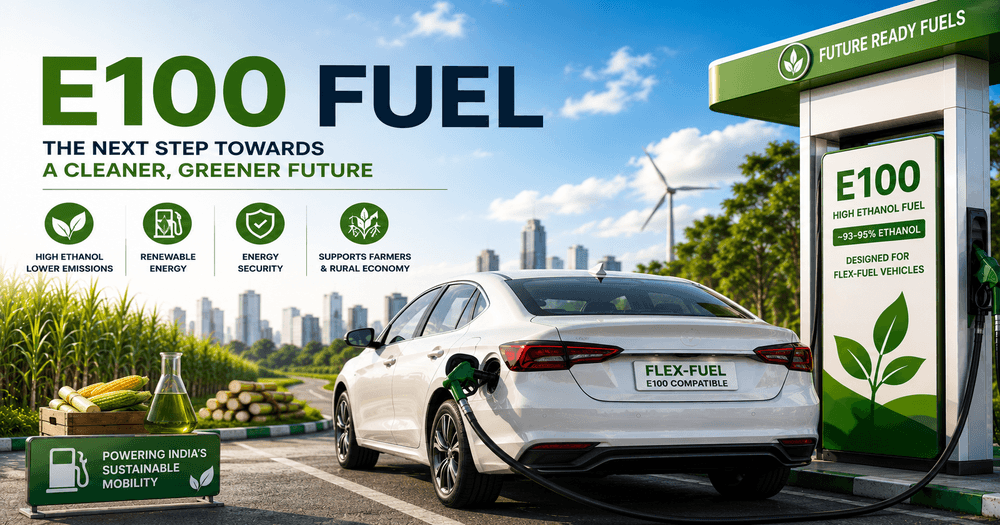
E100 fuel in India is now a legally recognised automotive fuel, following the Ministry of Road Transport and Highways’ amendment to Rule 115 of the Central Motor Vehicles Rules, 1989. The gazette notification, numbered G.S.R. 911(E) and published on October 26, 2026, opens the door for original equipment manufacturers to certify vehicles for 100% ethanol operation — and for fuel retailers to dispense E100 at the pump. This article breaks down what the rule change actually means, which vehicles qualify, what E100 costs to run, and what Indian car buyers should do right now.
What Is E100 Fuel and How Did India Get Here?
E100 fuel in India refers to anhydrous ethanol — 100% ethanol with zero petrol blending. Unlike E20, which blends 20% ethanol with 80% petrol and works in any modern petrol car, E100 requires a specifically engineered flex-fuel vehicle to operate safely. The India government approves E100 fuel milestone of October 2026 is the latest step in a policy journey that began with the Ethanol Blending Programme (EBP), accelerated through the National Biofuel Policy 2018 (as amended), and reached the E20 nationwide rollout before arriving at E85 pilots and now the E100 fuel approval in India 2026.
India’s motivation for this push is not abstract. The country spent an estimated Rs 85,000 crore in foreign exchange savings over the last decade through ethanol blending alone, according to the Ministry of Petroleum. Expanding from ethanol-blended fuel at 20% to 85% and now 100% reduces crude oil import dependence at every step — a live national priority given that India imports over 85% of its crude oil requirement. Sugarcane-based ethanol from Maharashtra, Uttar Pradesh, and Karnataka forms the primary feedstock; India’s biofuel production India capacity has expanded with 131 dedicated ethanol plants under long-term offtake agreements. The ethanol programme also delivers an environmental return — the government cites CO2 reductions equivalent to planting 1.75 crore trees across the programme’s history. Energy security India and agricultural income both improve when ethanol supply chains scale — two political and economic objectives that make E100 worth pushing even before the vehicles and pumps are fully ready.
The broader picture: alternative automotive fuels — ethanol, compressed biogas, hydrogen — are now India’s parallel track alongside the EV push. E100 is the most deployable of these because it uses existing liquid fuel infrastructure rather than requiring an entirely new dispensing and storage network. Renewable transportation fuel from sugarcane does not require a new charging grid.
E100 Approval Under Central Motor Vehicles Rules 1989 — The Rule Change Explained
The Ministry of Road Transport and Highways issued G.S.R. 911(E) on October 23, 2026, published in the Official Gazette on October 26, 2026. The notification amends Rule 115 of the Central Motor Vehicles Rules, 1989 — the rule that governs vehicle emission standards and fuel-related testing provisions. The specific change replaces references to “E85” with “E85 or E100” across the applicable emission testing provisions, extending the legal scope of recognised fuels to include pure ethanol alongside the existing 85% blend.
What the amendment does in practical terms: it creates a legal pathway for OEMs to seek type approval for vehicles designed to run on E100, requires vehicle emission certification testing under E100 operating conditions at ARAI or ICAT, and permits oil marketing companies and fuel retailers to dispense E100 at authorised outlets. The notification also raises the gross vehicle weight threshold in the relevant emission standards from 3,000 kg to 3,500 kg. Importantly, the amendment does not mandate E100 use, does not require existing petrol or E20 owners to change anything, and sets no commercial availability timeline for E100 at the retail level. It opens the regulatory door; the market and OEMs decide the pace of entry.
Buyers of connected car technology features should note that Hyundai’s BlueLink and Maruti’s Suzuki Connect platforms already monitor fuel consumption in real time — future FFV variants with these systems will report ethanol versus petrol mode running costs directly to the driver’s phone.
The Difference Between E20, E85, and E100 Fuel — What Each Means for Your Car
Understanding the difference between E20, E85, and E100 fuel is the most important piece of knowledge for any Indian buyer evaluating these fuels. The three blends sit at different points on the ethanol spectrum, and each demands a different level of fuel-system compatibility from the vehicle.
E20 contains 20% ethanol and 80% petrol — it works in every modern petrol car sold in India without engine or fuel system modification. E85 fuel contains 85% ethanol and 15% petrol; it requires a flex-fuel vehicle with an ethanol-compatible engine, corrosion-resistant fuel lines, ethanol-tolerant injectors, and a remapped ECU. E100 pushes this further — zero petrol content means zero compromise in the fuel system. Standard rubber seals, aluminium fuel components, and stock fuel injection system hardware degrade under sustained exposure to 100% ethanol. Only a purpose-built or fully certified flex-fuel vehicle (FFV) handles E100 safely.
| Parameter | E20 Petrol | E85 Fuel | E100 Fuel |
|---|---|---|---|
| Ethanol content | 20% ethanol, 80% petrol | 85% ethanol, 15% petrol | 100% ethanol (anhydrous) |
| Petrol content | 80% | 15% | 0% |
| Compatible with standard petrol cars | Yes — all modern cars | No | No |
| Requires flex-fuel vehicle | No | Yes | Yes |
| Available at Indian pumps | Yes — nationwide rollout | Limited — pilot pumps (Delhi, Mumbai) | Approved; 183 IndianOil outlets across 5 states |
| Mileage vs petrol equivalent | Broadly similar | Approx. 25–30% lower | Approx. 30–35% lower |
| Engine or fuel system change needed | No | Yes — FFV engine required | Yes — FFV plus high-ethanol engine calibration |
| India regulatory status | Mandatory blend nationwide | Approved; pilot phase active | Approved under CMVR 1989 Rule 115 (Oct 2026) |
| Emission benefit vs petrol | Moderate | Higher | Highest |
The table shows why E20 petrol is the safe default for today’s car buyers — no modification, no compatibility risk, nationwide availability. E85 and E100 are the choices for buyers who specifically purchase a certified FFV, know where the pumps are, and have calculated the running cost advantage.
Can Normal Petrol Cars Use E100 Fuel? The Clear Answer
No. Standard petrol cars cannot use E100, and attempting to do so risks serious and expensive fuel system damage. Can normal petrol cars use E100 fuel is the single most searched question on this topic — the answer must be unambiguous.
E100 has a higher oxygen content, a higher latent heat of vaporisation, and a lower energy density per litre compared to petrol. A standard petrol car’s fuel injection system is calibrated for petrol’s specific energy content — running 100% ethanol creates a lean fuel mixture, meaning the engine receives more oxygen than the fuel can support. Sustained lean running raises combustion temperatures and can damage pistons, valves, and combustion chamber surfaces. Separately, the rubber seals in standard fuel systems absorb ethanol and swell or degrade over time. Aluminium fuel system components corrode under prolonged ethanol contact. Fuel-system compatibility with high-ethanol blends requires specific materials, not standard petrol-grade components.
Running E100 in a non-FFV also voids the powertrain warranty of every OEM that sells cars in India — fuel system damage from incorrect fuel use falls outside the warranty coverage terms. The repair cost of replacing corroded fuel lines, failed injectors, and degraded seals significantly exceeds any per-litre price saving from E100.
What Makes a Flex-Fuel Vehicle Different from a Regular Petrol Car?
A flex-fuel vehicle (FFV) uses four categories of engineering that a regular petrol car does not have. First: corrosion-resistant fuel components — fuel tank lining, fuel lines, injector seals, and pump internals use stainless steel, fluoropolymer, or high-density polyethylene materials rated for sustained ethanol contact. Second: higher-flow fuel injectors — ethanol’s lower energy density (approximately 34% less than petrol by volume) requires the injectors to deliver more fuel volume per combustion cycle to maintain equivalent power. Third: a flexible ECU with an ethanol content sensor — the sensor (a dedicated inline unit or wideband oxygen sensor logic) detects the ethanol percentage in the tank in real time and adjusts engine calibration, ignition timing, and fuelling maps accordingly across the E20–E85 or E20–E100 range. Fourth: cold-start enrichment calibration — ethanol’s high latent heat makes vaporisation difficult below 10°C. The FFV ECU adds a richer fuel mixture at startup in cold conditions to compensate. This is flex-fuel engine technology at the system level — not a sticker or a software switch, but a fundamental redesign of the fuel delivery and management architecture.
E100 Fuel-Compatible Cars in India — Which Vehicles Qualify?
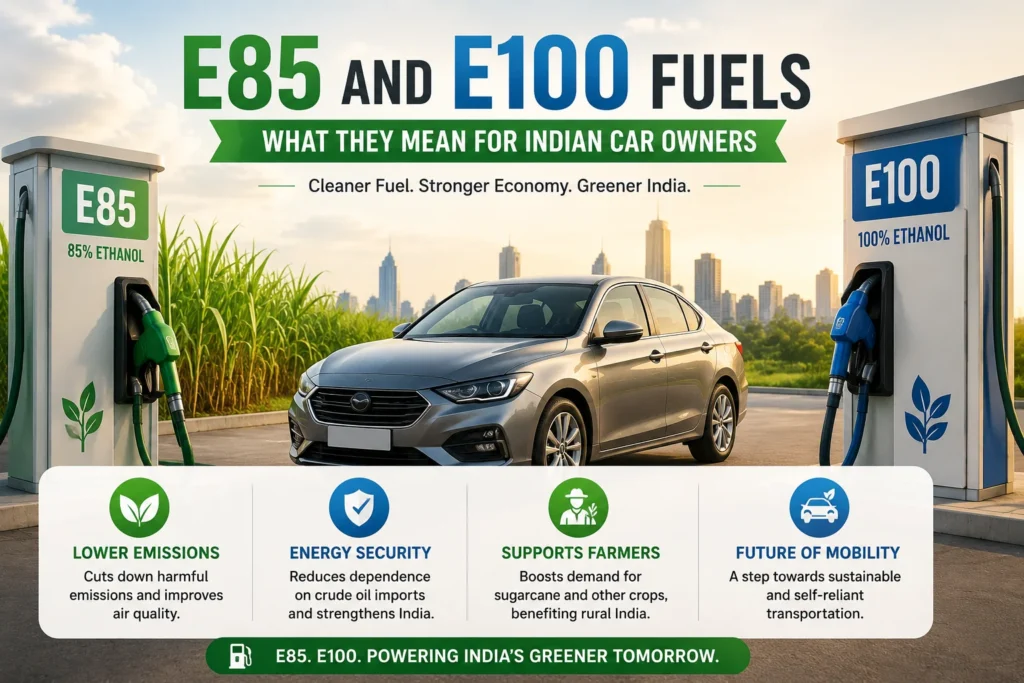
E100 fuel compatible cars in India remain limited to a very short list in October 2026. The Maruti Suzuki Wagon R Flex Fuel, unveiled in June 2026, is India’s first production-ready FFV — it runs on blends from E20 to E100 and represents the first E100 flex-fuel vehicles India latest news development from a mass-market OEM. The car uses a modified version of the 1.2-litre K-Series engine with ethanol-compatible fuel system components and a flexible ECU. ARAI certification status for the Wagon R Flex Fuel’s E100 operating range was not confirmed in official OEM communication at the time of this writing; buyers should verify directly with Maruti Suzuki before operating on E100.
Toyota demonstrated an Innova HyCross prototype running on E100 as part of India’s ethanol pilot programme; this remains a demonstration vehicle, not a production-certified E100 model. Tata Motors and Hyundai have announced FFV development intentions; no confirmed launch timeline or ARAI certification for E100 operation had been announced as of October 2026.
The distinction between “announced” and “ARAI E100-certified” is critical. A manufacturer announcing FFV intentions means engineers are working on it. ARAI E100 type approval means the vehicle has passed India’s official vehicle emission certification test cycle under E100 operating conditions and received regulatory clearance to run on E100 commercially. Buyers should ask dealers for the ARAI type approval document, not rely on press releases.
Government’s FFV Push — What OEMs Are Required to Do from 2025 Onwards
The Ministry of Road Transport and Highways had directed OEMs to progressively launch flex-fuel vehicles beginning in 2025. Under this directive, new petrol car models must progressively support higher ethanol blends — with E20 compatibility as the current floor. E100 fuel in India for flex-fuel vehicles remains a voluntary certification at this stage; no OEM is mandated to achieve E100 type approval. The CMVR 1989 Rule 115 amendment creates the regulatory pathway, but does not compel OEMs to use it on a mandated timeline. The framework for alternative automotive fuels under Indian motor vehicle law is now complete — execution remains with OEMs and oil marketing companies.
E100 Fuel Price in India — Is It Actually Cheaper to Run?
The E100 fuel in India pump price has not been officially declared at a national level as of October 2026. The reference data point from the ethanol fuel rollout: when India’s first E85 pump opened in Delhi on World Environment Day (June 5, 2026), E85 was priced at Rs 82.12 per litre — approximately Rs 20 cheaper than E20 petrol at Rs 102.12 per litre at the same location. E100 is expected to carry a similar or slightly wider discount to petrol, given higher ethanol content. For calculation purposes, a range of Rs 75–85 per litre serves as a working estimate for E100 pricing in sugarcane-surplus states; buyers should verify the live price at their nearest outlet before making a purchase decision.
The cost per kilometre comparison is the metric that matters, not cost per litre. Ethanol delivers approximately 30–35% fewer kilometres per litre than petrol in an equivalent engine, because ethanol contains less energy per litre.
CNG Running Cost vs Petrol — Monthly Savings Calculator
Base assumption: 1,500 km/month, Delhi reference prices (E85 at Rs 82/litre as proxy; E100 estimated at Rs 78/litre; petrol at Rs 102/litre)
| Parameter | Petrol | E85 Fuel (reference) | E100 Fuel (estimated) |
|---|---|---|---|
| Fuel price per litre | Rs 102 | Rs 82 | Rs 78 (est.) |
| Real-world km per litre | 15 kmpl | ~10.5–11 kmpl | ~10–10.5 kmpl |
| Cost per km | Rs 6.80 | Rs 7.45–7.80 | Rs 7.43–7.80 |
| Monthly fuel cost (1,500 km) | Rs 10,200 | Rs 11,175–11,700 | Rs 11,143–11,700 |
E100 running cost estimates are illustrative. Verify actual E100 pump price and real-world mileage of your specific FFV model before making a financial decision.
At current reference prices, E100 does not deliver a lower cost per kilometre than petrol — the mileage penalty from ethanol’s lower energy density offsets the per-litre price advantage. The renewable transportation fuel case for E100 is therefore primarily an emissions and energy security argument, not a pure running cost saving at today’s fuel prices. This picture changes if petrol prices rise significantly or if the government subsidises E100 pricing in states with ethanol surplus. Crude oil import reduction at the national level is the economic benefit — the saving accrues to the government’s import bill, not directly to the individual buyer’s fuel cost.
Where Can You Fill E100 Fuel in India Today?
As of mid-2026, Indian Oil Corporation operates approximately 183 E100 dispensing outlets across five states — Maharashtra, Karnataka, Uttar Pradesh, Delhi, and Tamil Nadu. The government has targeted 500 ethanol fuel stations by end-2026 and 5,000 by end-2027, as stated by Petroleum Minister Hardeep Singh Puri. E100 outlets are integrated into existing retail fuel stations rather than standalone dedicated facilities. E85 is available at pilot pump locations in Delhi (launched June 5, 2026) and Mumbai. Biofuel production India capacity and the dispensing network are expanding in parallel — the constraint today is not production volume but retail infrastructure rollout pace.
E100 Ethanol Fuel Rules in India — What the Regulations Actually Say
E100 ethanol fuel rules in India are now codified under Rule 115 of the Central Motor Vehicles Rules 1989, as amended by gazette notification G.S.R. 911(E) dated October 23, 2026 and published October 26, 2026. The rule change extends the definition of recognised fuels for flex-fuel vehicles from E85 to include E100, and aligns emission testing provisions accordingly. The amendment also raises the gross vehicle weight classification threshold from 3,000 kg to 3,500 kg within the same notification.
Under the amended rules, the Ministry of Road Transport and Highways pathway for E100 requires: (1) the OEM designs the vehicle as an FFV from the ground up, using compatible materials, ECU calibration, and fuel system components; (2) the vehicle undergoes type approval and vehicle emission certification at ARAI or ICAT under E100 operating conditions; (3) the type approval document confirms the usable fuel range (e.g., E20 to E100 or E85 to E100) for that specific model. Fuel retailers dispensing E100 must comply with applicable petroleum dispensing regulations under the Petroleum and Explosives Safety Organisation (PESO). E100 certification for OEMs remains voluntary; the mandate currently covers E20 compatibility as the floor standard, not E100. The amended rule distinguishes E85 and E100 provisions clearly — a vehicle certified for E85 only does not automatically qualify for E100 operation without separate type approval covering that fuel range.
Tips for Indian Buyers Considering E100 or Flex-Fuel Vehicles
Tip 1 — Ask for the ARAI type approval document, not the press release. An OEM announcement of FFV technology and an ARAI E100 type approval are two different documents. Before operating any vehicle on E100, ask the dealer to produce the ARAI type approval certificate that specifically covers the E100 fuel operating range. “Flex-fuel capable” and “ARAI-certified for E100” are not interchangeable descriptions.
Tip 2 — Calculate cost per kilometre at your city’s E100 pump price, not cost per litre. E100 will cost less per litre than petrol at most pumps. It also delivers approximately 30–35% fewer kilometres per litre. At current reference prices (E100 estimated Rs 75–85/litre), the running cost per kilometre sits roughly level with petrol, not below it. The economics change if petrol prices rise or if E100 is subsidised in your state — recalculate with live prices before deciding.
Tip 3 — Do not run E100 in a standard petrol car. Fuel system damage from incorrect fuel use falls entirely outside the OEM warranty of every petrol car sold in India. E100 degrades standard rubber seals, corrodes aluminium fuel components, and causes lean-running engine damage. The repair bill for a compromised fuel system runs well above any per-litre saving from ethanol. Check the fuel type specified in the owner’s manual before filling.
Tip 4 — Plan for weaker cold-start performance in north Indian winters. Ethanol requires more heat to vaporise than petrol. FFVs running E100 or high-ethanol blends in Delhi, Punjab, Rajasthan, and the hill states experience harder cold starts below 10°C. Most FFV systems switch to petrol automatically at startup and move to CNG or ethanol after the engine reaches operating temperature — confirm this with the dealer and keep the petrol tank at a usable level through winter months.
Tip 5 — Verify E100 pump proximity before buying an FFV. IndianOil’s 183 E100 outlets across five states represent a very limited network for a country with over 80,000 petrol pump stations. Buying a dedicated FFV for E100 operation makes financial sense only when an E100 outlet sits within daily driving range. Check the current IndianOil outlet locator and the Ministry of Petroleum’s ethanol station map before committing to an FFV purchase on the strength of E100 economics.
FAQ — People Also Ask About E100 Fuel in India
Q1. What is E100 fuel in India and is it approved?
E100 fuel in India is anhydrous 100% ethanol — no petrol blending — and it became officially approved on October 26, 2026, through gazette notification G.S.R. 911(E) issued by the Ministry of Road Transport and Highways. The notification amends Rule 115 of the Central Motor Vehicles Rules 1989 to include E100 alongside E85 as a recognised fuel for flex-fuel vehicles. The India government approves E100 fuel under a framework that requires purpose-designed FFVs; existing petrol cars do not qualify. The E100 fuel approval in India 2026 follows a draft notification published April 27, 2026, after which public objections were considered before the final gazette issue.
Q2. Can normal petrol cars use E100 fuel?
No. Standard petrol cars cannot safely run on E100. The rubber seals, aluminium components, and fuel injectors in regular petrol cars are not rated for sustained contact with 100% ethanol. Running E100 in a non-FFV causes fuel system corrosion, seal failure, and lean-mixture engine damage. This type of damage falls outside OEM warranty coverage. Only ARAI-certified flex-fuel vehicles with corrosion-resistant fuel system components, ethanol-tolerant injectors, and a flexible ECU should use E100.
Q3. What is the difference between E20, E85, and E100 fuel?
The difference between E20, E85, and E100 fuel comes down to ethanol content and vehicle compatibility. E20 (20% ethanol, 80% petrol) works in all modern petrol cars without modification and is the current nationwide mandatory blend in India. E85 fuel (85% ethanol, 15% petrol) requires a flex-fuel vehicle with certified ethanol-compatible systems. E100 (100% ethanol) requires a fully certified FFV with the highest level of ethanol tolerance across engine, fuel system, and ECU calibration. The comparison table in the section above covers all parameters including mileage impact, pump availability, and regulatory status.
Q4. Which cars in India are compatible with E100 fuel?
E100 fuel compatible cars in India as of October 2026: the Maruti Suzuki Wagon R Flex Fuel (launched June 2026, compatible E20 to E100 as per Maruti’s claims — ARAI E100 certification status should be verified at the dealership). Toyota’s Innova HyCross E100 prototype has been demonstrated but is not a production-certified model for E100 retail use. E100 flex-fuel vehicles India latest news from Tata and Hyundai covers development intentions, not launch timelines. The ARAI website and MoRTH official notifications carry the current certified vehicle list — buyers should cross-reference these before purchase.
Q5. What are the E100 ethanol fuel rules in India for vehicles?
E100 ethanol fuel rules in India sit within Rule 115 of the Central Motor Vehicles Rules 1989, as amended by G.S.R. 911(E) dated October 23, 2026. The rule requires OEMs to design and certify vehicles from the ground up as FFVs, undergo ARAI or ICAT vehicle emission certification under E100 operating conditions, and receive type approval confirming the usable fuel range. E100 certification remains voluntary for OEMs — the current OEM mandate covers E20 compatibility as the mandatory floor. Retailers dispensing E100 must comply with PESO petroleum dispensing regulations. A vehicle certified only to E85 does not automatically qualify for E100 operation.
The Fuel Is Ready. The Infrastructure Has to Catch Up. Here Is Where India’s E100 Story Actually Stands
E100 fuel in India has the regulatory foundation it needed as of October 26, 2026. G.S.R. 911(E) and the Rule 115 amendment represent a genuine structural milestone — the CMVR 1989 framework now legally recognises 100% ethanol as an automotive fuel, giving OEMs a clear pathway to type approval and retailers a legal basis to dispense it. That part is done.
What is not done: the pump network (183 outlets across 5 states, targeting 500 by end-2026 and 5,000 by 2027), the production-certified E100 vehicle lineup (Wagon R Flex Fuel is the sole mass-market FFV as of this writing), and the cost-per-kilometre case for individual buyers (E100 at current prices does not beat petrol per km — it is level at best).
For Indian buyers evaluating a car purchase today: the rational choice is an E20-compatible modern petrol car — every car sold in India qualifies, and E20 is available at every petrol pump nationwide. Watch the FFV market over the next 12–24 months. If IndianOil’s 5,000-station target by 2027 tracks close to schedule, and if Maruti, Tata, and Hyundai confirm E100 type approvals on production vehicles, the economics of owning an FFV improve at the next purchase cycle — not this one. India’s crude oil import bill and the agricultural income angle ensure that government support for biofuel production India and energy security India will not slow down.